
The best insulation types for UK garden buildings
TL;DR:
- Choosing the correct insulation improves comfort, moisture control, and building longevity.
- Various insulation types like PIR, mineral wool, and sheep’s wool suit different needs and budgets.
- Proper insulation installation in floor, walls, and roof is essential for all-year use and efficiency.
Choosing the wrong insulation for your garden building is one of those mistakes that only becomes obvious once the cold creeps in or the damp starts to show. Many UK homeowners assume any insulation will do the job, but the reality is that your choice of material affects everything: how warm the space feels in January, how cool it stays in July, and even how long the building itself lasts. This guide walks you through the main insulation types, where and how to install them, and the factors that matter most when making your decision. By the end, you’ll feel confident about the right choice for your project.
Table of Contents
- Why insulation matters for garden buildings
- Overview of insulation types for garden buildings
- Where and how to insulate your garden building
- Key considerations when choosing insulation
- The surprising difference the right insulation makes
- Custom solutions for your garden building
- Frequently asked questions
Key Takeaways
| Point | Details |
|---|---|
| Insulation is essential | Proper insulation keeps garden buildings comfortable and damp-free all year. |
| Material choice matters | Costs, eco impact, and fit differ widely, so compare insulation types carefully. |
| Zone every surface | Insulate the roof, floor, and walls to prevent heat loss and cold spots. |
| DIY or professional | Both approaches work, but complex installs may call for expert help. |
Why insulation matters for garden buildings
Let’s be honest. Insulation is not the most exciting part of planning a garden building. It’s hidden inside the walls, under the floor, and above your head in the roof space. But it might be the single most important decision you make for the long-term comfort and usability of your cabin.
The UK climate is not kind to uninsulated structures. Winters are damp and cold, summers can be surprisingly warm, and the in-between seasons bring their own challenges. Without proper insulation, a garden room can feel like a fridge in December and a greenhouse in August. Neither is much use if you’re trying to work, relax, or create in the space.
Proper insulation is essential for all-year comfort and prevents moisture problems in UK garden buildings.
This is something we see time and again with customers who’ve built or bought a cabin without giving insulation proper thought. They end up spending more on heating to compensate, or worse, dealing with condensation and damp that damages the structure and its contents over time.
Here’s what good insulation actually does for your garden building:
- Keeps the temperature stable throughout the year, so you’re not forever adjusting heating or fans
- Manages moisture by reducing the likelihood of condensation forming on cold surfaces
- Reduces heating costs because an insulated space holds warmth far more efficiently
- Extends the life of the building by protecting the timber from repeated wetting and drying
- Adds usable value by making the space genuinely comfortable all year, not just in summer
There’s a common misconception that summerhouses don’t need insulation at all. This might be true if you’re only going to use the space for a few months a year. But if you want a garden office, a gym, a studio, or a guest room, you need insulation from the start. Retrofitting it later is possible but more disruptive and often more costly.
Good moisture control is closely linked to insulation, and it’s worth thinking about both together rather than separately. A well-insulated cabin with poor ventilation can still develop condensation issues. Getting the balance right from the outset saves a lot of hassle later.
Pro Tip: If you’re planning a year-round garden office or studio, budget for insulation as a core part of the project cost, not an optional add-on. It will save you far more in heating bills and maintenance over the years.
Overview of insulation types for garden buildings
Now that you understand why insulation matters, it’s time to look at what’s actually available. There are several main materials used in UK garden buildings, each with its own strengths, price points, and best-use scenarios.
Various insulation types like PIR board, mineral wool, sheep’s wool, and eco-friendly solutions are widely used for UK garden buildings, and understanding the differences between them helps you choose with confidence.
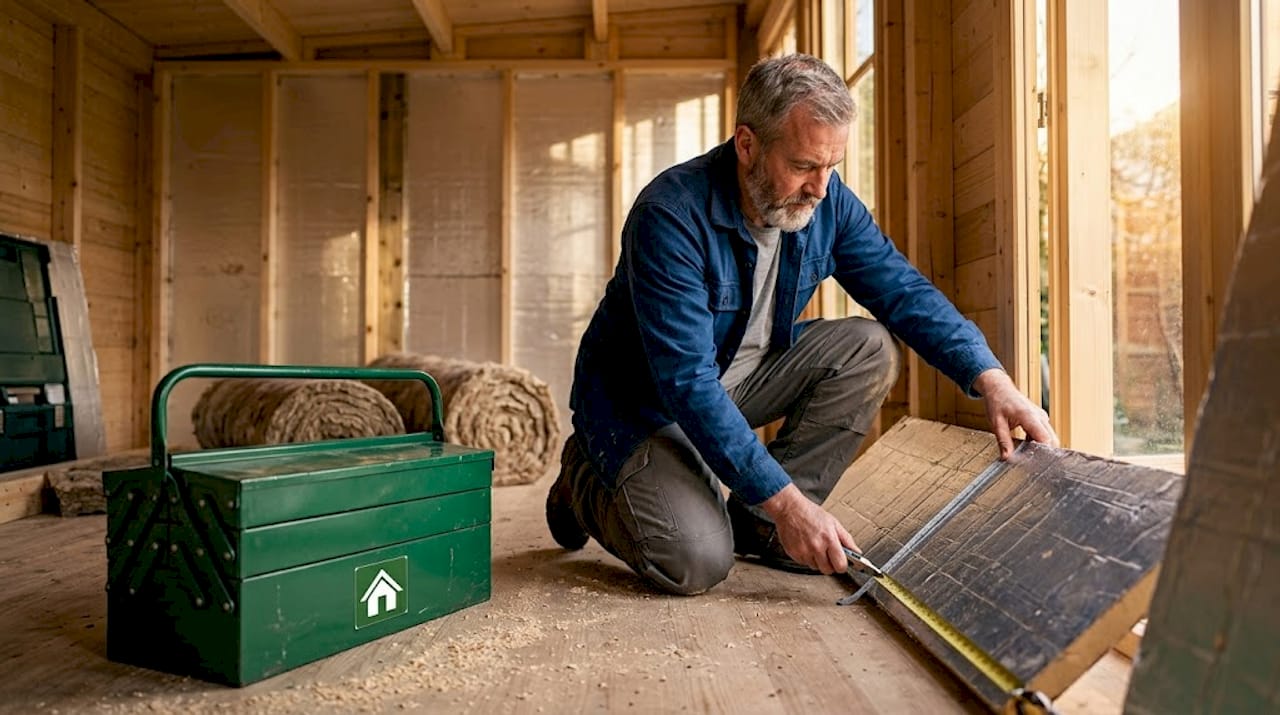
PIR board (polyisocyanurate) is a rigid foam panel that offers an excellent thermal performance for its thickness. This matters a lot in garden buildings where wall cavities are relatively slim. PIR achieves a very low thermal conductivity (around 0.022 to 0.028 W/mK), meaning thinner panels can do the same job as thicker alternatives. It’s moisture resistant, easy to cut with a craft knife, and available from most builders’ merchants. The trade-off is cost: PIR is more expensive than mineral wool per square metre.
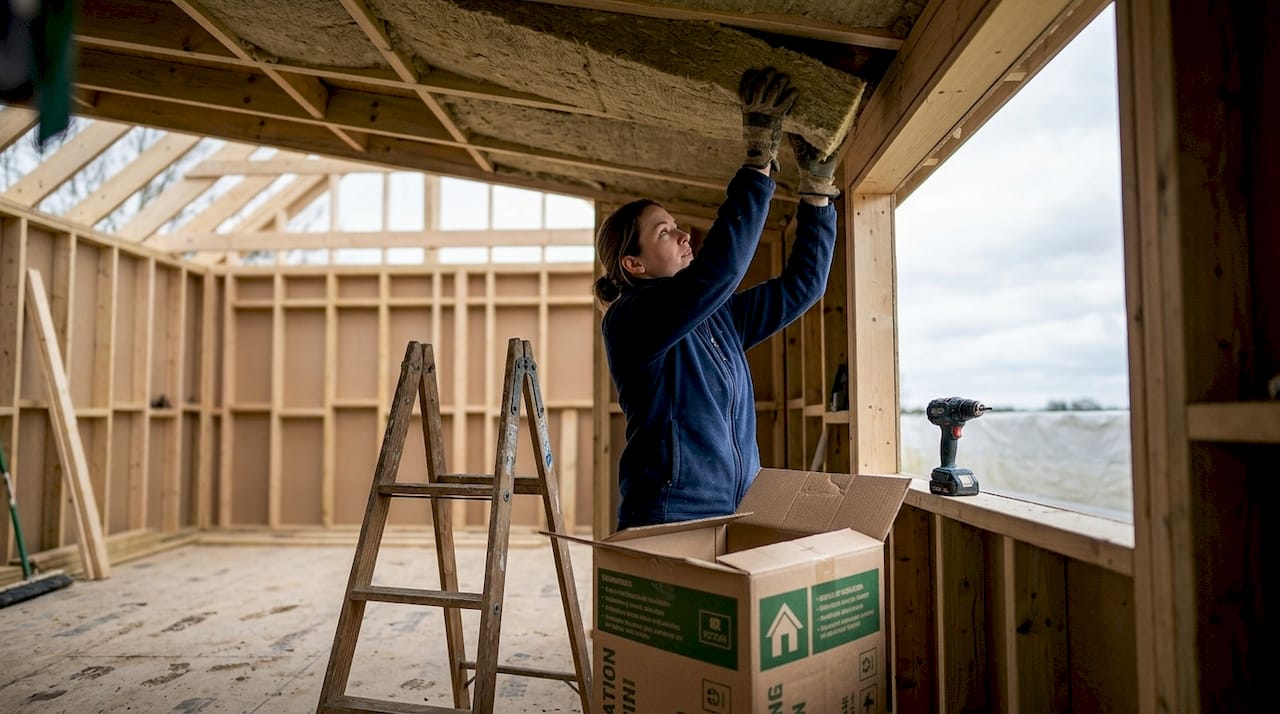
Mineral wool (also sold as glass wool or rock wool) is the most widely used insulation in the UK. It’s affordable, easy to fit between timber battens, and offers good sound absorption as well as thermal performance. If noise from outside is a concern, mineral wool has a useful acoustic benefit that PIR boards don’t match. It does absorb moisture if not protected properly, so a vapour barrier is important when using this material.
Sheep’s wool is gaining popularity as a natural, breathable insulation option. It handles moisture brilliantly, absorbing and releasing it without losing its thermal properties. It’s safe to handle without protective gear, which makes it particularly appealing for DIY installers. The cost sits between PIR and mineral wool depending on the product grade.
Sustainable options for insulation include natural fibres such as sheep’s wool and wood fibre board, which are a great fit for homeowners who want to reduce the environmental impact of their build.
Wood fibre board is another natural choice. It’s made from compressed timber fibres and offers good thermal mass, meaning it helps regulate temperature swings throughout the day. It’s particularly suited to roof applications and is fully recyclable.
| Insulation type | Thermal value (W/mK) | Relative cost | Eco rating | Best application |
|---|---|---|---|---|
| PIR board | 0.022 to 0.028 | Higher | Moderate | Walls, roof, floor |
| Mineral wool | 0.033 to 0.044 | Lower | Moderate | Walls, partitions |
| Sheep’s wool | 0.035 to 0.040 | Mid range | High | Walls, roof |
| Wood fibre board | 0.038 to 0.050 | Mid to high | High | Roof, walls |
Pro Tip: For most year-round garden rooms in the UK, PIR board in the walls and roof combined with mineral wool in partitions gives you strong performance at a reasonable overall cost.
Where and how to insulate your garden building
Knowing your insulation material is only half the story. Equally important is understanding where to insulate and in what order. Many people focus on the walls and forget that up to 25% of heat loss in a poorly insulated building can come through the floor or roof alone.
The three critical zones are the floor, the walls, and the roof. Each one needs to be addressed, and leaving any one of them uninsulated creates a weak point that undermines everything else.
Here’s a simple sequence to follow when planning insulation for a new or existing garden building:
-
Start with the floor. Cold rising from the ground is often underestimated. Properly insulating the floor of your garden cabin prevents cold spots and saves on heating, especially in winter months when ground temperatures drop significantly. Fit insulation between the floor joists before laying the deck boards, or use rigid PIR board beneath a raised floor platform.
-
Move to the walls. Install insulation between the wall studs or battens, pressing the material firmly into place without compressing it too much (compression reduces its effectiveness). Always include a vapour barrier on the warm side of the insulation to prevent moisture from inside the cabin moving into the wall structure.
-
Finish with the roof. Roof insulation tips often emphasise the importance of leaving a ventilation gap between the insulation and the roof covering to allow any trapped moisture to escape. This is particularly important with flat or low-pitched roofs common on garden rooms.
-
Check for gaps and cold bridges. A cold bridge is where a material with poor thermal performance (like a timber joist or metal fixing) runs through the insulation layer, creating a path for heat to escape. Seal gaps with expanding foam or insulation tape.
-
Consider airtightness. Insulation works best in a reasonably airtight building. Fitting draught strips around doors and windows makes a noticeable difference to how warm the space feels.
The full insulation process for a garden log cabin covers all three zones and is worth reading before you begin, particularly if it’s your first time insulating a timber-framed structure.
Common installation mistakes include: squashing insulation into a space that’s too tight, skipping the vapour barrier, leaving gaps at corners or around windows, and not accounting for the roof ventilation gap. Each of these errors chips away at the overall performance of the insulation system.
Pro Tip: Do the floor first, always. It’s the easiest zone to overlook and the hardest to fix after the interior is finished.
Key considerations when choosing insulation
With the material options and installation zones covered, the next step is deciding what’s right for your specific project. There’s no single correct answer. The best insulation for your garden building depends on several personal factors.
Your insulation decision factors include cost, eco impact, how you plan to use the building, and ease of installation, all of which will influence the right choice for your situation.
Budget is usually the first consideration. If you’re working with a tight budget, mineral wool gives you solid performance at the lowest material cost. If you can stretch a little further, PIR board delivers a better thermal result in thinner applications, which can be worth the extra spend in a compact garden room.
Sustainability matters to many homeowners, particularly those who are conscious of the environmental impact of their materials. Sheep’s wool and wood fibre board are both excellent choices in this regard. They’re produced from renewable sources, have low embodied energy compared to foam boards, and are biodegradable at end of life.
How you’ll use the building has a big effect on what you need. A home office that you’ll use five days a week in all weathers needs a higher specification than a summer pottery shed. Guest accommodation needs good acoustic performance as well as thermal comfort. A garden gym needs less insulation than an artist’s studio where you might sit still for hours in cold weather.
Your DIY confidence is worth being honest about. Rigid PIR boards require precise cutting for a good fit, which is manageable but takes care. Sheep’s wool and mineral wool are more forgiving and easier for first-time installers to work with.
| Factor | PIR board | Mineral wool | Sheep’s wool | Wood fibre |
|---|---|---|---|---|
| Cost | Higher | Lower | Mid | Mid to high |
| Thermal performance | Excellent | Good | Good | Good |
| DIY friendliness | Moderate | Easy | Easy | Moderate |
| Eco credentials | Moderate | Moderate | High | High |
| Moisture handling | Good | Needs barrier | Excellent | Good |
The key takeaway is this: there is no universal winner. Each material has a situation where it performs best. Matching the right insulation to your building’s needs, your budget, and your installation skills is the whole point of this decision.
The surprising difference the right insulation makes
Here’s something most insulation guides won’t tell you: the difference between adequate insulation and well-chosen insulation is far greater than most people expect. We’ve seen customers who installed perfectly functional insulation but chose the wrong type for their climate zone or usage, and ended up with a cabin that felt stuffy in summer or still lost too much heat through a poorly sealed floor.
The single most overlooked tip for first-time builders is to treat insulation as a system, not a collection of individual materials. The floor, walls, and roof need to work together. A perfectly insulated roof will not save you if cold is rising through the floor unchecked.
We’ve also noticed that the right insulation dramatically reduces ongoing maintenance. Buildings that manage moisture well through proper insulation and ventilation simply last longer. The timber doesn’t swell and shrink as dramatically with seasonal changes. Door frames stay true. Finishes last longer.
For those using their cabin through the colder months, reading up on winter warmth tips alongside your insulation planning makes a real difference. Small details like draught-proofing and heating placement compound the benefits of good insulation considerably.
The honest truth? The homeowners who are happiest with their garden buildings are almost always the ones who didn’t cut corners on insulation at the start.
Custom solutions for your garden building
If you’re ready to move from planning to building, we’d love to help you get it right from the start.

At Log Cabin Kits, we specialise in bespoke cabin design tailored to how you want to use your space. Whether you’re planning a home office, studio, gym, or guest room, insulation is built into the design process, not bolted on as an afterthought. Browse our garden log cabin ideas for inspiration, or explore our range of custom build log cabins to see what’s possible. We’re happy to talk through your insulation options and help you choose the right specification for your project and budget. Just get in touch.
Frequently asked questions
Can I insulate my existing garden building, or must it be done during the build?
You can insulate most existing garden buildings, but planning at the build stage allows for better material selection and a much cleaner installation overall.
Which insulation type is best for garden office use?
PIR board offers high thermal efficiency for year-round use, but sheep’s wool or mineral wool are worth considering if sustainability or acoustic performance is a priority for your workspace.
Does insulation prevent damp in my garden cabin?
Proper insulation helps reduce condensation, but good ventilation is equally important. Combining both approaches is the most reliable way to manage damp and moisture in a garden building.
Can I use eco-friendly insulation in a DIY garden room?
Yes, sheep’s wool and wood fibre panels are DIY-friendly, widely available in the UK, and well suited to sustainable garden building projects without specialist tools or skills.
Is a double skin wall construction suitable for insulating?
Yes, a double skin wall construction provides the perfect cavity into which you can place insulation. View our double skin log cabins here.