

Blog


TL;DR:
- Permitted development rights allow UK homeowners to build garden structures without planning permission if specific limits are met.
- Key conditions include size, height, location, and use restrictions to ensure qualifying projects stay incidental to the home.
- If limits are exceeded or certain areas are protected, full planning permission is required before construction.
Most UK homeowners assume that adding any structure to their garden means a trip to the planning office. That’s simply not true. Permitted development rights (PDRs) allow you to build a wide range of garden buildings without ever submitting a planning application, provided you stay within certain limits. This guide walks you through exactly what those limits are, which designs qualify, when you do need permission, and how to make the most of what PDRs genuinely allow. By the end, you’ll feel confident about your next garden project.
Table of Contents
- Understanding permitted development rights for garden buildings
- What you can build: Permitted sizes, locations, and uses
- Design and build: Navigating common pitfalls
- When planning permission is required and what to do
- Why design flexibility is the real benefit of permitted development
- Transform your garden with a custom design
- Frequently asked questions
Key Takeaways
| Point | Details |
|---|---|
| Legal shortcuts available | Permitted development rights let you add many garden buildings without planning permission if you follow the rules. |
| Size and use limitations | There are clear limits on height, footprint, and how you use your garden building under permitted development. |
| Design for compliance | Careful planning and documentation can help you build a unique space while staying within the law. |
| Exceptions exist | Some properties and uses still require full planning permission, so check all restrictions before building. |
| Expert help available | Custom solutions and guidance make it much easier to create the ideal garden room or office. |
Understanding permitted development rights for garden buildings
Permitted development rights are a set of rules built into UK planning law that grant automatic permission for certain types of building work. You don’t need to apply. You don’t need to wait. As long as your project meets the criteria, you’re legally allowed to go ahead.
For garden buildings specifically, PDRs cover a broad range of structures. Think log cabins, garden offices, workshops, sheds, and summerhouses. The Planning Portal outbuildings rules confirm that these structures are treated as “outbuildings” and fall under permitted development when specific conditions are met.
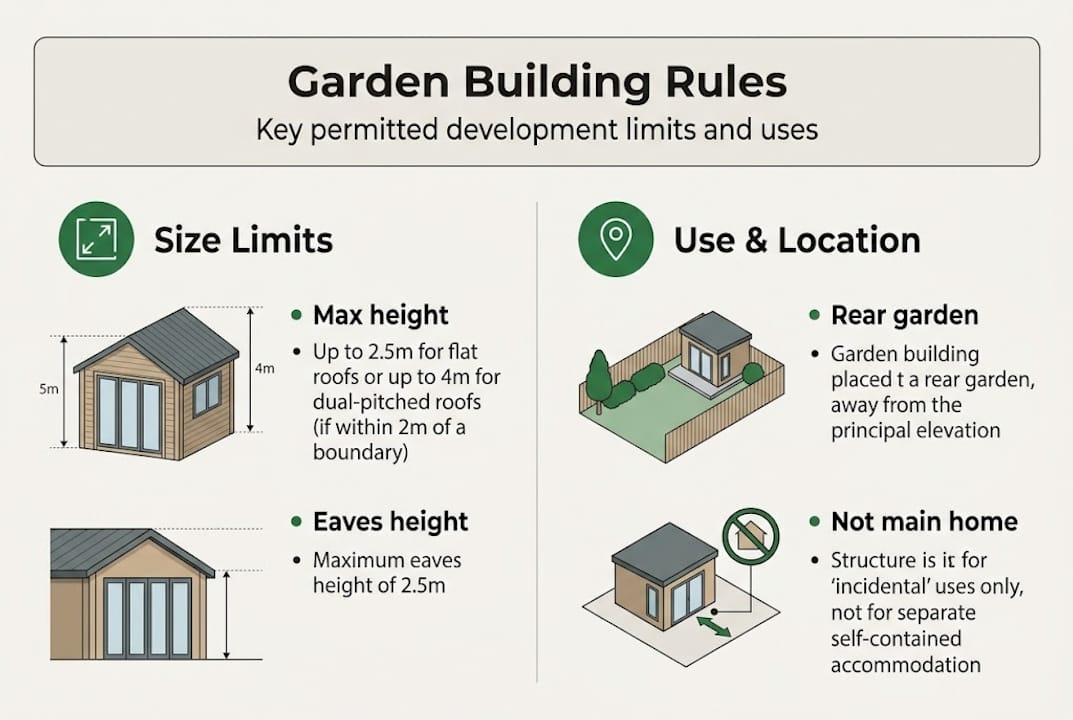
So, what counts as a garden building under these rules? Generally, it’s any structure in your garden that’s incidental to the enjoyment of your home. That includes home offices, hobby rooms, gyms, and storage buildings. It does not include structures intended as separate dwellings.
Key PDR conditions for garden buildings:
- The building must be in the curtilage (garden area) of a house
- It must not be forward of the principal elevation (the front of your home)
- It must not be used as self-contained living accommodation
- It must sit within the permitted height and footprint limits
- It must not cover more than 50% of the total garden area
| PDR allowance | Detail |
|---|---|
| Maximum eaves height | 2.5 metres |
| Maximum overall height (dual pitch roof) | 4 metres |
| Maximum overall height (other roof types) | 3 metres |
| Maximum coverage | 50% of garden area |
| Permitted uses | Office, gym, hobby room, storage |
| Prohibited uses | Sleeping accommodation, separate dwelling |
As confirmed by planning guidance, permitted development rights allow homeowners to erect certain garden buildings without full planning permission if specific limits are met. That’s a significant saving in time, cost, and stress.
Pro Tip: Check whether your property has had PDRs removed through an Article 4 Direction. This can happen in conservation areas or on certain housing estates. Your local council’s website should list any Article 4 Directions in your area.
What you can build: Permitted sizes, locations, and uses
Now that you understand what PDRs are, let’s get practical. The physical constraints matter a lot here, and it’s worth knowing them before you start sketching out plans.
Height rules vary depending on your roof type and how close the building sits to a boundary. If your building is within 2 metres of a boundary, the maximum height drops to 2.5 metres overall. Further away, you can go up to 4 metres with a dual-pitched roof or 3 metres with any other roof style.
Location rules are equally important. Your garden building cannot be placed in front of the principal elevation of your house. In practice, this means nothing in your front garden and nothing that protrudes beyond the front wall of your home on the side.
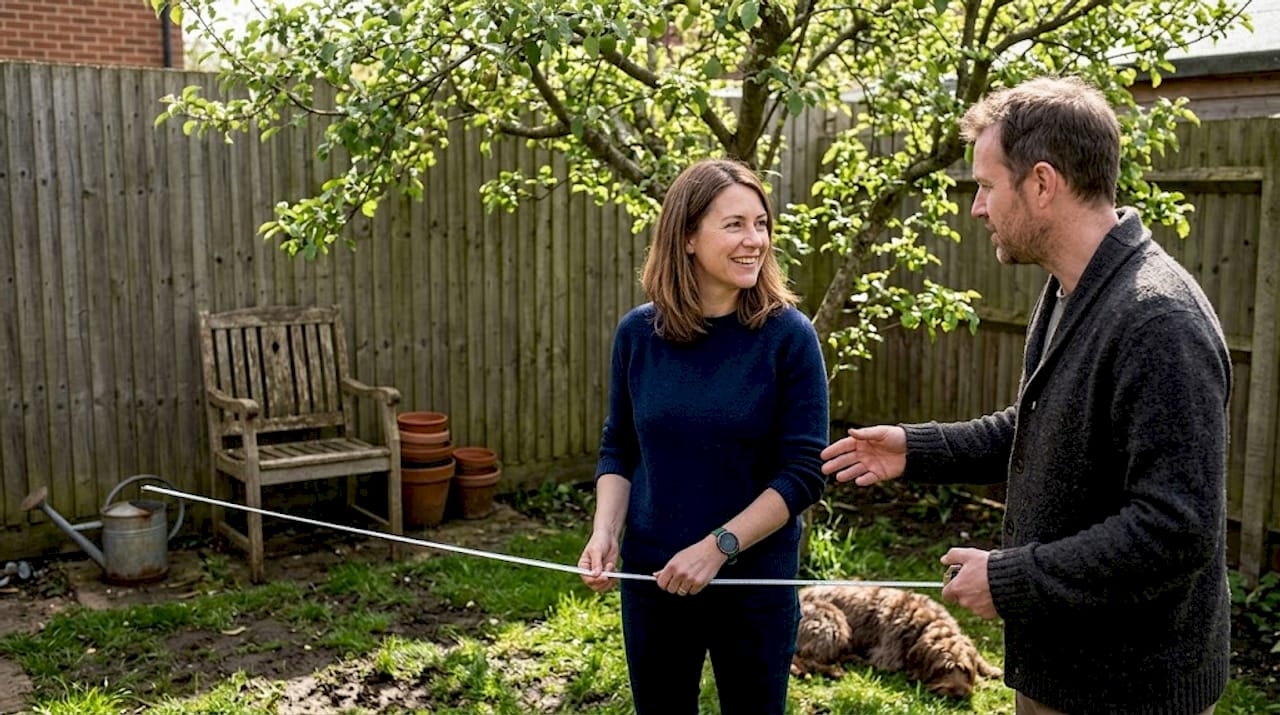
The official technical guidance also makes clear that no more than half your total garden area can be covered by outbuildings combined. That includes any existing sheds, garages, or extensions already in place.
| Scenario | Permitted development? |
|---|---|
| 3m shed, 5m from boundary | Yes |
| 4m cabin with dual pitch, central garden | Yes |
| Building within 2m of boundary, 3.5m tall | No |
| Garden office used as sleeping quarters | No |
| Front garden summerhouse | No |
As detailed in planning permission for garden cabins, garden buildings must not be used as self-contained living accommodation under permitted development rights. This is one of the most common misunderstandings we see.
Quick checklist: Does your project qualify?
- Is the building in your rear or side garden (not in front of the house)?
- Does it stay within the height limits for your roof type and boundary distance?
- Will it cover less than 50% of your total garden when combined with other outbuildings?
- Is the intended use incidental (office, gym, storage) rather than residential?
- Is your property free from Article 4 Directions or listed building status?
If you answered yes to all five, you’re very likely within permitted development. For further detail on guidance on garden cabin size limits, it’s worth reading up before you order.
Worth knowing: Around 70% of garden building projects in the UK proceed under permitted development without any planning application at all.
Design and build: Navigating common pitfalls
Knowing the rules is one thing. Building within them is another. There are a handful of common mistakes that catch homeowners out, and most of them are entirely avoidable.
Foundations are often overlooked. A solid, level base isn’t just good practice; it’s essential for compliance and longevity. As noted in guidance on laying compliant foundations, incorrect foundations or poor placement can lead to non-compliance and enforcement action. Concrete pads, timber frames, and paving slabs are all common choices, but the right option depends on your soil type and building size.
Design choices can also affect compliance in subtle ways. Adding large windows on a boundary-facing wall, for example, could raise objections from neighbours even if the build itself is technically within PDR limits. Insulation and utility connections are fine for incidental use, but if you’re fitting a kitchen or bathroom, you’re moving into territory that suggests residential use, which falls outside PDRs.
“The most successful garden building projects start with a clear brief and a solid understanding of the rules. Rushing the planning stage is where most problems begin.”
Common pitfalls to avoid:
- Exceeding height limits, even by a small margin
- Placing the building too close to a boundary without adjusting the height
- Using the building in a way that suggests it’s a separate dwelling
- Failing to check for Article 4 Directions before starting work
- Not accounting for existing outbuildings when calculating the 50% coverage rule
For inspiration that works within these boundaries, take a look at permitted development and design trends to see what’s popular right now.
Pro Tip: Document your build with dated photographs and keep a copy of any drawings or measurements. If you ever sell your home or face a query from the council, this paperwork will save you a great deal of time.
Timeline tips:
- Allow 2 to 4 weeks for site preparation and foundation work
- Order your building with enough lead time for delivery
- Notify your home insurer once the building is complete
- Keep all receipts and correspondence in one folder
When planning permission is required and what to do
PDRs cover a lot of ground, but they don’t cover everything. There are specific situations where you will need to apply for full planning permission, and it’s important to know them before you commit to a design.
You’ll need planning permission if:
- Your property is a listed building or within its curtilage
- You live in a designated area such as a National Park, Area of Outstanding Natural Beauty, or World Heritage Site
- Your property is subject to an Article 4 Direction that removes PDRs
- Your intended building exceeds the permitted size or height limits
- You plan to use the building as self-contained living accommodation
As highlighted in a step-by-step planning permission guide, some properties are excluded from permitted development rights, including listed buildings and some conservation areas. If you’re unsure whether your property falls into one of these categories, your Local Planning Authority (LPA) is the right first port of call.
| Scenario | PDR or planning permission? |
|---|---|
| Standard garden cabin, rear garden | Permitted development |
| Cabin in a National Park | Planning permission required |
| Office in listed building grounds | Planning permission required |
| Cabin exceeding 4m height | Planning permission required |
| Cabin intended as holiday let | Planning permission required |
How to apply for planning permission:
- Contact your LPA for a pre-application discussion
- Prepare drawings, site plans, and a design statement
- Submit your application via the Planning Portal
- Pay the relevant fee (currently £258 for householder applications in England)
- Wait for a decision, usually within 8 weeks
For more detail on listed building rules, the listed building consent rules page is a helpful resource. And if you want a broader overview of the process, our guide to planning permission for log cabins covers the full picture.
Checklist for consulting your LPA:
- Confirm whether your property has any Article 4 Directions
- Ask about any local design guidelines that might affect your build
- Request written confirmation of any verbal advice given
- Check whether a Certificate of Lawful Development might be useful
Why design flexibility is the real benefit of permitted development
Most people treat PDRs as a box-ticking exercise. Stay under the height limit, keep it out of the front garden, and don’t call it a bedroom. Done. But that mindset misses the bigger picture.
In our experience, the constraints of permitted development often push homeowners toward more thoughtful, creative designs. When you can’t build big, you build clever. We’ve seen beautifully crafted garden offices, art studios, and yoga rooms that are far more considered than anything that might have sprawled across a larger footprint.
The functional flexibility is genuinely underappreciated too. A single structure can serve as a home office during the week, a gym on weekends, and a creative studio whenever inspiration strikes. PDRs don’t limit that. They simply ask that it stays incidental to your home life, which, frankly, most of us want anyway.
For a dose of garden building inspiration, it’s worth seeing how other homeowners have made the most of their permitted development allowance. The results are often stunning.
The rules aren’t a ceiling. They’re a starting point.
Transform your garden with a custom design
If this guide has sparked some ideas, you’re in the right place. At Log Cabin Kits, we specialise in bespoke cabin design that works beautifully within permitted development rules. Every build is tailored to your garden, your needs, and your style.
Not sure where to start? Browse our garden log cabin gallery to see what’s possible, or explore our garden building inspiration pages for ideas across every use case. Whether you’re dreaming of a home office, a gym, or a peaceful retreat, we’ll help you get there without the planning headache.
Frequently asked questions
Are garden offices allowed under permitted development rights?
Most garden offices qualify under permitted development if they meet the height and location rules, and are used for work rather than as residential accommodation. They must remain incidental to the main home.
How close to my house can I build a garden building without planning permission?
There’s no minimum distance from your house, but your building must not sit forward of the principal elevation. Height restrictions tighten to 2.5 metres overall if the building is within 2 metres of a boundary.
What happens if my property is in a conservation area?
Permitted development rights are often restricted or removed entirely in conservation areas. Always check with your Local Planning Authority before starting any work to avoid enforcement issues.
Can I connect my garden building to water and electricity under permitted development?
Yes, utility connections are generally fine for incidental uses like an office or gym. All electrical and plumbing work must comply with the relevant building regulations regardless of planning status.
Do I need to notify my council if I build under permitted development rights?
You don’t usually need to notify the council, but keeping records of your build is strongly recommended, especially if you plan to sell your home in the future.


