

Blog


Most people assume a wooden cabin is basically a bonfire waiting to happen. It’s an understandable worry, but it’s not quite right. Solid log construction is surprisingly resilient to fire, and with the right precautions in place, your garden cabin can be a genuinely safe space. Whether you’re planning a cosy retreat, a home office, or a guest room at the bottom of the garden, understanding fire safety from the start makes everything simpler. This guide covers the real risks, what UK law says, and the practical steps you can take to keep your cabin safe.
Table of Contents
- Why fire safety matters for log cabins
- How fire-resistant are log cabins really?
- Legal fire safety requirements for UK log cabins
- Essential fire safety measures and maintenance
- Expert advice and common pitfalls
- Explore safe, bespoke log cabins
- Frequently asked questions
Key Takeaways
| Point | Details |
|---|---|
| Thick log cabins resist fire | Solid logs over 6 inches provide significant fire resistance due to their charring effect. |
| Legal duties for guest use | Cabins used for sleeping or as holiday lets require official fire assessments and safety measures. |
| Maintenance is critical | Annual checks of smoke alarms, chimneys, and exits keep log cabins safe year-round. |
| Expert design improves safety | Using specialist materials and layouts further reduces fire risk in bespoke log cabins. |
Why fire safety matters for log cabins
Garden log cabins are popping up across the UK in growing numbers. People are using them as offices, gyms, hobby rooms, and increasingly as sleeping spaces for guests or holiday lets. That shift in use changes the fire safety picture considerably.
The UK sees around 39,000 building fires per year, though no specific data exists for garden log cabins alone. What we do know is that any structure used for sleeping carries a higher level of responsibility.
“A garden cabin used for overnight guests isn’t just a shed with a bed. It carries real obligations around fire detection, escape routes, and risk assessment.”
Here are the key fire concerns specific to log cabins:
- Wood construction means the structure itself is combustible, even if it resists fire better than you’d expect
- Remote location in the garden can delay detection and response
- Wood-burning stoves are a popular addition but introduce chimney and spark risks
- Electrical installations in outbuildings are sometimes done informally, raising the risk of faults
- Sleeping or guest use triggers additional legal obligations under UK fire safety law
For a broader overview, our guide on fire safety in garden buildings is a great starting point.
How fire-resistant are log cabins really?
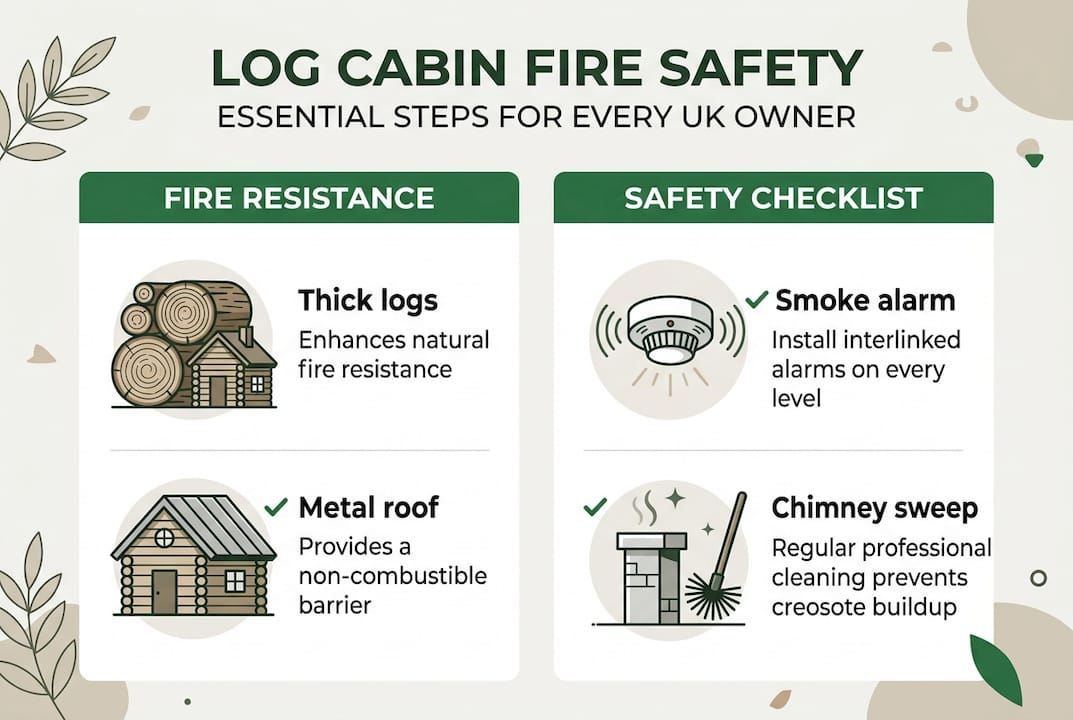
Here’s where things get interesting. Most people picture a log cabin going up in flames quickly, but the reality is quite different. Thick solid log walls actually create what’s known as a char barrier. When the outer surface of a log burns, it forms a layer of charred wood that insulates the timber beneath and slows the fire’s progress significantly.
Solid log walls of six inches or more can achieve a one-hour fire resistance rating through this charring effect. In some configurations, resistance of up to three hours has been recorded in testing. That’s comparable to, and sometimes better than, standard light-frame timber construction.
“The char layer acts like a natural shield. It’s one of the reasons solid log construction has been used in fire-prone regions for centuries.”
Here’s a quick comparison to put it in context:
| Construction type | Approximate fire resistance |
|---|---|
| Standard timber frame | 30 to 45 minutes |
| Solid log (6 inches) | Up to 1 hour |
| Solid log (8+ inches) | Up to 2 to 3 hours |
| Brick or concrete block | 2 to 4 hours |
Of course, the logs themselves are only part of the picture. Your roof material and insulation choices matter too. Mineral wool insulation is non-combustible and adds a meaningful layer of protection. Pairing it with a Class A rated roof covering gives you the best overall fire performance. You can read more about insulation for fire safety and the specifics of roof insulation for cabins on our site.
Pro Tip: If you’re specifying a bespoke cabin, ask for logs of at least six inches thickness. It’s a straightforward upgrade that meaningfully improves fire resistance without changing the look of the cabin.
Legal fire safety requirements for UK log cabins
So what does the law actually say? For a private garden cabin used only by your household, the legal requirements are relatively light. But the moment your cabin is used for sleeping guests or let out as holiday accommodation, the rules change.
Under the Regulatory Reform (Fire Safety) Order 2005, a fire risk assessment is mandatory for any premises where paying guests sleep. This applies to garden cabins used as holiday lets, Airbnb-style rentals, or even informal paid stays.
Here’s what you need to cover:
- Carry out a written fire risk assessment and review it regularly
- Install interlinked smoke alarms on every level of the cabin
- Fit a carbon monoxide (CO) detector if there’s a stove, boiler, or any fuel-burning appliance
- Ensure clear escape routes are always accessible and unobstructed
- Provide appropriate fire extinguishers where required (see fire extinguisher requirements for guidance)
- Keep records of all checks, assessments, and maintenance carried out
It’s also worth checking whether your cabin needs building regulations approval, particularly if it’s used as sleeping accommodation. Our article on building regulations for log cabins explains when approval is needed, and you can also check the latest log cabin planning rules for 2026.
| Use type | Fire risk assessment required? | Smoke alarms required? | CO detector required? |
|---|---|---|---|
| Private household use | No (recommended) | Yes | If stove fitted |
| Guest accommodation | Yes | Yes | Yes |
| Holiday let | Yes | Yes | Yes |
Essential fire safety measures and maintenance
Whether your cabin is for personal use or guests, there are some straightforward steps that make a real difference. None of these are complicated, and most take very little time.
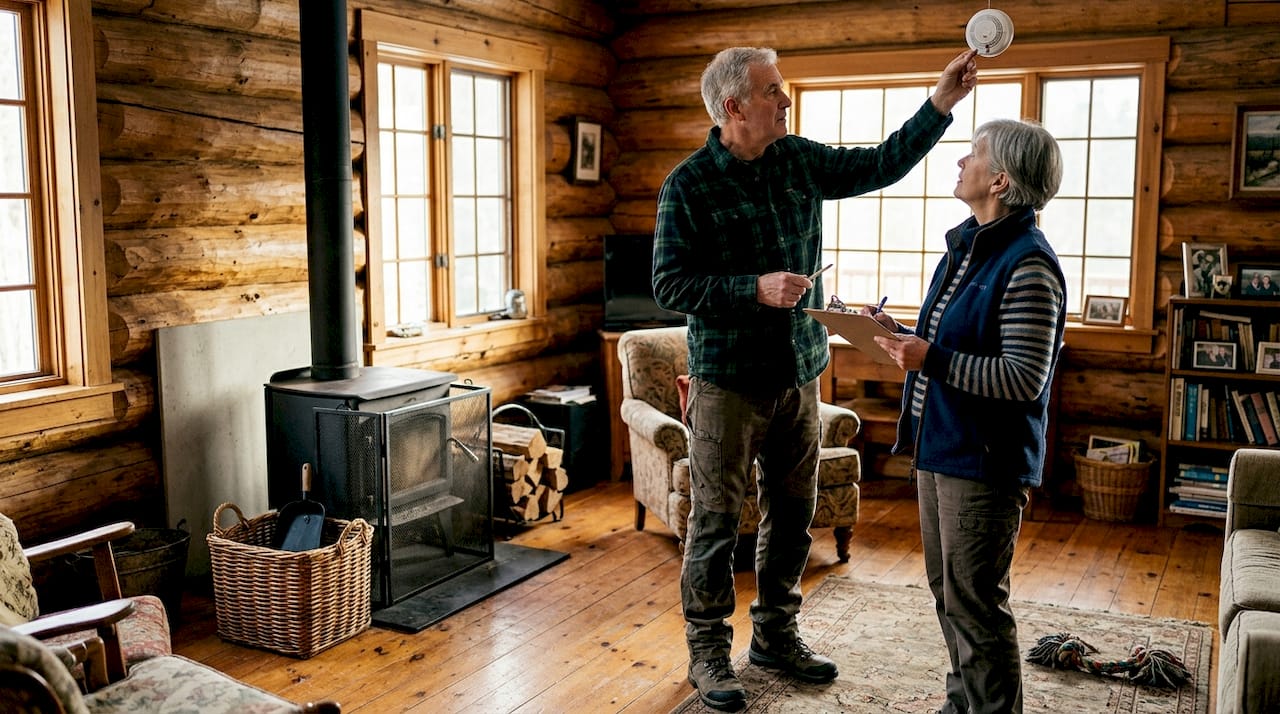
- Fit smoke alarms on every level and test them monthly. Replace batteries annually.
- Install a CO detector near any wood burner, gas appliance, or boiler
- Have your chimney swept annually if you use a log burner or open fire. Creosote (a tar-like residue from burning wood) builds up and is a leading cause of chimney fires
- Use a fire guard around your log burner at all times, especially if children or pets are present
- Don’t overload sockets or use extension leads as a permanent solution
- Keep the area around the cabin clear of dry leaves, stored wood, and other combustible materials
- Check escape routes seasonally to make sure nothing is blocking doors or windows
- Store barbecues and outdoor cooking equipment away from the cabin walls
For a full seasonal checklist, our log cabin maintenance tips guide covers everything you need to stay on top of throughout the year. It’s also worth scheduling regular fire safety checks if your cabin is used commercially.
Pro Tip: Set a recurring reminder every six months to walk around your cabin and check alarms, exits, and the condition of any stove or chimney. It takes ten minutes and could genuinely save lives.
According to official guidance, fire and spark guards for log burners and annual chimney sweeps are among the most important preventative measures for any cabin with a solid fuel appliance.
Expert advice and common pitfalls
Even well-intentioned cabin owners make avoidable mistakes. Here are the ones we see most often, and how to sidestep them.
As noted in fireproof cabin design research, thicker logs combined with Class A roofing, mineral wool insulation, and clear defensible space around the structure give you the strongest overall protection. Wildfires are rare in the UK, but an overgrown garden with dry vegetation close to the cabin walls is still a risk worth managing.
Common pitfalls to avoid:
- Blocking fire exits with furniture, stored items, or garden equipment
- Using unprotected wood burners without a proper hearth, guard, or flue liner
- Skipping annual chimney maintenance because the stove seems to be working fine
- Assuming a private cabin needs no safety measures just because guests aren’t paying
- Neglecting electrical checks on outbuilding wiring, which can degrade faster than indoor installations
- Not having a clear escape plan if the cabin is used for sleeping
For bespoke or rental cabins, a professional fire safety assessment is genuinely worth the investment. It gives you documented evidence of compliance and peace of mind that you haven’t missed anything. Our guide on fire safety precautions covers this in more detail.
“The most common mistake isn’t ignorance. It’s assuming that because nothing has gone wrong yet, nothing will. Fire safety is about removing the conditions that allow problems to start.”
Explore safe, bespoke log cabins
If you’re thinking about adding a log cabin to your garden, getting the design right from the start is the easiest way to build safety in from day one. A well-specified cabin with the right wall thickness, roof materials, and layout makes every fire safety measure simpler to implement.

We specialise in custom build log cabins and bespoke cabin design that can be tailored to your exact needs, including fire safety considerations. Browse our log cabin gallery for inspiration, and get in touch with our team to talk through your requirements. We’re here to make the whole process straightforward and stress-free.
Frequently asked questions
How fire-resistant are modern log cabins compared to brick buildings?
Thick solid log cabins can achieve fire resistance of up to 1 to 3 hours through the charring effect, sometimes outperforming standard timber frame constructions. Brick and concrete generally still provide higher overall resistance, but solid log cabins perform far better than most people expect.
Are fire risk assessments mandatory for all UK garden log cabins?
Not for private household use, but a fire risk assessment is required if the cabin is used for sleeping guests or let out as holiday accommodation under the Fire Safety Order.
What are the most important maintenance tasks for fire safety in log cabins?
Annual chimney sweeping, monthly smoke alarm checks, and keeping escape routes clear are the top priorities. Official guidance also highlights fire and spark guards as essential for any cabin with a log burner.
Are there official fire safety rules for log cabin kitchens?
If your cabin has a kitchen and is used for holiday lets or sleeping, you must implement kitchen fire prevention measures as part of your overall fire risk assessment. This includes safe appliance use and appropriate detection equipment.


