
BS 476 fire rating explained: what it means in 2026
A BS 476 fire rating tells you how a building material or element performed in a British Standard fire test, covering either how it reacts to fire on its surface or how long it resists fire before failing. The standard is still referenced in UK projects during a transition period, but the government is removing it from Approved Document B in stages: reaction-to-fire references went on 2 March 2025, and fire-resistance references follow on 2 September 2029.
Two things sit under the BS 476 label. First, surface and reaction tests that produce national classes (Class 0, Class 1, and so on). Second, time-based resistance tests, measured in minutes, from Parts 20 and 22 of the series. Both types appear on manufacturer certificates, and you need to know which one you are looking at.
Pro Tip: Always ask manufacturers for the full test report, not just a summary certificate. The report should state the specific BS 476 part number, the test specimen details, the accredited laboratory, and whether EN 13501 testing has also been carried out. If it only says “tested to BS 476” with no part number, treat it as incomplete evidence.
Key takeaways
BS 476 fire ratings cover two distinct properties, reaction to fire and fire resistance, and the standard is being withdrawn from UK regulations in stages, with EN 13501 now the required classification system for reaction-to-fire properties and the required route for resistance properties from September 2029.
| Point | Details |
|---|---|
| Two types of rating | BS 476 covers surface reaction (national classes) and time-based resistance (minutes); always confirm which one a certificate refers to. |
| Withdrawal is staged | Reaction-to-fire BS 476 references removed from Approved Document B on 2 March 2025; resistance references follow on 2 September 2029. |
| Results cannot be converted | A BS 476 test result does not produce an EN 13501 classification; separate EN testing is required for EN evidence. |
| Always request the full report | Ask for the test report, part number, specimen details, lab accreditation, and EN evidence alongside any BS 476 certificate. |
| Logcabinkits bespoke option | Logcabinkits can adjust cabin specifications to match cladding, roofing, and lining requirements; use the bespoke design page to start the conversation. |
Table of Contents
- Where did BS 476 come from, and why does it matter?
- Which parts of BS 476 cover which tests?
- What does a BS 476 fire rating actually tell you?
- How does BS 476 compare with BS EN 13501?
- What does BS 476 Part 22 cover, and what should you ask for?
- How to check a BS 476 claim on any product
- The UK regulatory timeline: when does BS 476 stop being accepted?
- How are BS 476 fire tests actually carried out?
- What this means for garden log cabins and timber outbuildings
- How BS 476 compares with fire rating systems used internationally
- Where BS 476 tests fall short compared with modern standards
- What materials and products are commonly tested under BS 476?
- BS 476 ratings in procurement and legal disputes
- A practical note on specifying fire performance for garden buildings
- Bespoke garden log cabins built with your specification in mind
- Sources
Where did BS 476 come from, and why does it matter?
The BS 476 series is a long-standing collection of British Standards developed to give the construction industry a consistent way to measure how building materials and structures behave in fire. It grew over decades into a multi-part series because fire behaviour is not one single thing: a material can spread flames across its surface while remaining structurally intact for an hour, or vice versa.
The series expanded to cover two broad areas. Reaction-to-fire tests look at surface behaviour: how quickly flames spread, how much heat a material contributes, and whether it ignites easily. Resistance-to-fire tests look at how long a complete element, such as a wall or door, holds back fire, heat, and smoke before it fails.
BS 476 remained the dominant UK framework for decades because it was embedded in building regulations, insurance requirements, and procurement specifications. Architects, contractors, and manufacturers all understood the language of “30-minute fire door” or “Class 1 surface spread.” That familiarity is part of why the transition to European EN standards has taken time, and why the staged withdrawal approach was chosen rather than an overnight switch.
Which parts of BS 476 cover which tests?
The series runs across many part numbers. These are the ones you will most often see on certificates and specifications:
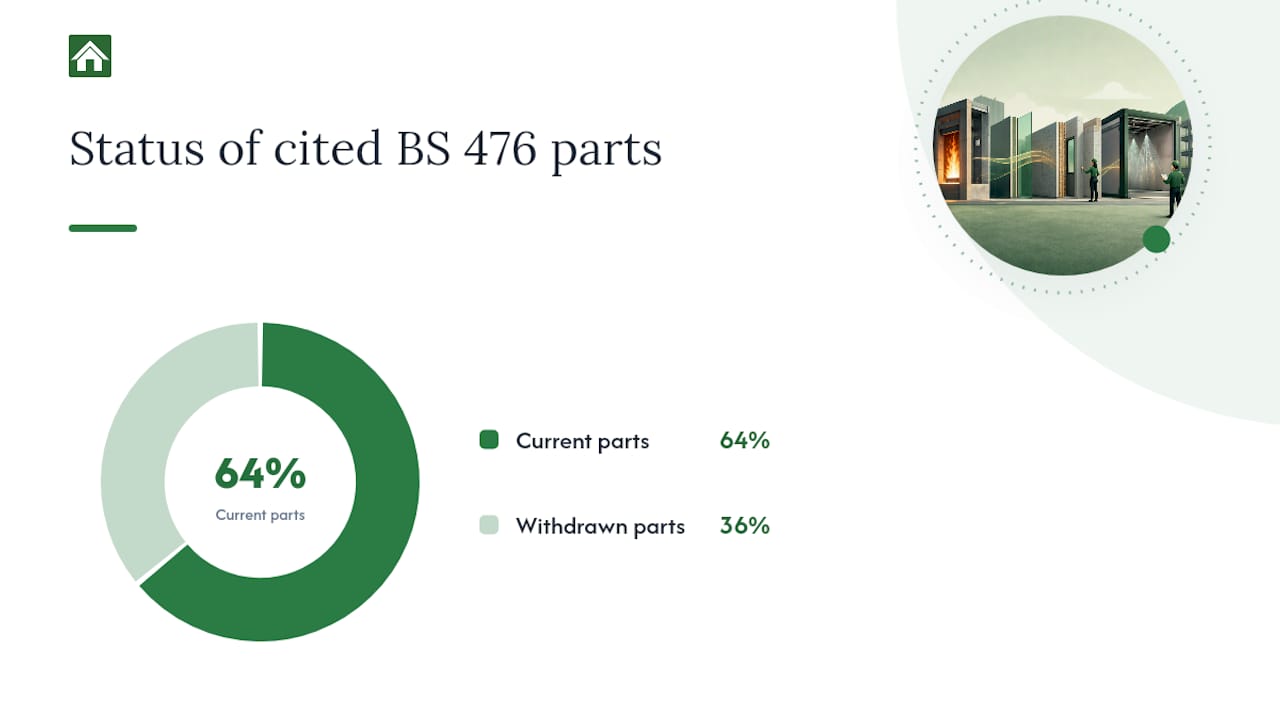
- Part 3 — External fire exposure of roofs (surface test for roof coverings)
- Part 4 — Non-combustibility test for materials (withdrawn)
- Part 6 — Fire propagation test for products (withdrawn)
- Part 7 — Surface spread of flame test (withdrawn)
- Part 11 — Heat emission test (withdrawn)
- Part 20 — Fire resistance of elements of construction (general principles and loadbearing elements)
- Part 21 — Fire resistance of loadbearing elements
- Part 22 — Fire resistance of non-loadbearing elements (partitions, doorsets, glazed screens)
- Part 23 — Contribution of components to fire resistance of a structure
- Part 24 — Fire resistance of ventilation ducts
- Part 31.1 — Methods for measuring smoke penetration through doorsets and shutter assemblies
Parts 20 and 22 are the ones most commonly cited on product certificates today. They produce time-based results covering integrity (stopping flames and hot gases), insulation (limiting heat transfer), and, for loadbearing elements, structural stability.
Parts 6 and 7, which produced the familiar national surface classes, have been withdrawn and replaced by EN 13501-1 reaction-to-fire classifications. If a product certificate still references only Part 6 or Part 7 results, that evidence is no longer current.
What does a BS 476 fire rating actually tell you?
The phrase “fire rating” gets used loosely, and that causes real problems on site. There are two distinct meanings, and mixing them up leads to wrong specifications.
Reaction to fire describes how a material behaves when exposed to a heat source: does it ignite, spread flames, or contribute fuel to a fire? Under BS 476, this produced national classes such as Class 0 (the best, used in Approved Document B for certain wall and ceiling linings) and Class 1 through Class 4 for surface spread of flame. These classes came from Parts 6 and 7 tests.
Fire resistance describes how long a complete element holds back fire. A fire door tested to BS 476 Part 22 means the doorset maintained integrity (no flames or hot gases passing through) for a duration measured under standardised furnace conditions. Some results also include an insulation criterion, shown as “EI 60” in EN notation or expressed as separate integrity and insulation times in BS 476 reports.
Pro Tip: When a manufacturer says a product is “BS 476 rated,” ask which part and which criterion. A Part 7 Class 1 surface result and a Part 22 60-minute resistance result are completely different things. A certificate that does not specify the part number is not usable as specification evidence.
How does BS 476 compare with BS EN 13501?
The short answer: they measure similar things but use different test methods, different classification scales, and the results cannot be swapped between systems.
BS EN 13501 is the European classification standard that is now the required route in UK regulations. It covers:
- BS EN 13501-1: Reaction to fire (replaces BS 476 Parts 6 and 7 with EN classes A1, A2, B, C, D, E, F)
- BS EN 13501-2: Resistance to fire for construction products (replaces BS 476 Parts 20 to 24 with REI, EI, R classifications and time in minutes)
The key practical point: BS 476 results cannot be converted into EN 13501 classifications. A product that achieved 60 minutes under BS 476 Part 22 does not automatically hold an EI 60 classification under EN 13501-2. Retesting under EN procedures is normally required to obtain an EN class.
The move to EN standards is not just administrative. As the RICS journal notes, EN test methods are more recent, regularly reviewed, and better aligned with modern building science than some of the older BS 476 procedures they replace. The transition also simplifies specification routes by removing two parallel classification systems that caused confusion.
What does BS 476 Part 22 cover, and what should you ask for?
Part 22 is the test most specifiers encounter when dealing with fire doors, partitions, and glazed screens. It covers non-loadbearing elements, meaning elements that do not carry structural loads but must resist the passage of fire, heat, and smoke.
A typical Part 22 test places the specimen in a furnace and exposes it to a standardised time-temperature curve. The lab records:
- Integrity: how long before flames or hot gases pass through gaps or cracks
- Insulation: how long before the unexposed face reaches a temperature that would ignite materials on the other side
Results appear on the test report as time values, commonly covering periods of fire resistance, which indicate the duration the specimen prevented flame or heat passage. A report might state “integrity 60 minutes, insulation 30 minutes,” which means the door stopped flames for an hour but allowed significant heat transfer after 30 minutes.
When a supplier claims Part 22 compliance, ask for all of the following:
- The full laboratory test report (not a summary or marketing sheet)
- The specific BS 476 Part 22 reference and edition tested to
- The test specimen description: dimensions, construction, ironmongery, seals, glazing if any
- The accredited laboratory name and UKAS accreditation number
- The date of the test and whether the certificate is still within its validity period
- Confirmation of whether EN 13501-2 testing has also been completed
Pro Tip: Many fire door certificates list the exact ironmongery, intumescent seals, and glazing used during the test. If you specify different hardware or seals on site, the test evidence no longer applies to your assembly. Always match site specification to test specimen details.
How to check a BS 476 claim on any product
Verifying a fire rating claim takes five minutes if you know what to look for. Here is a straightforward checklist:
- Confirm the part number. The certificate must state which BS 476 part was used. “Tested to BS 476” alone is not sufficient.
- Check the criterion. Integrity only, or integrity and insulation? Loadbearing stability if relevant?
- Read the specimen description. Does it match what you are specifying? Different dimensions, fixings, or finishes may invalidate the result.
- Verify the laboratory. The test should have been carried out by a UKAS-accredited fire-testing laboratory.
- Check the date. Older certificates may predate current editions of the standard. Ask whether the product has been retested.
- Ask about EN evidence. Given the withdrawal timeline, ask whether the product also holds an EN 13501 classification.
Relying solely on a legacy BS 476 certificate after the relevant withdrawal date carries real risk. The BBA warns that products without EN evidence face potential non-compliance and certification hurdles as the transition completes. Insurance and warranty implications can follow.
Pro Tip: If a project is already under way and you are relying on BS 476 evidence under transitional provisions, confirm acceptance in writing with your local authority building control officer before proceeding. Verbal assurances are not sufficient.
The UK regulatory timeline: when does BS 476 stop being accepted?
The staged removal from Approved Document B works like this:
- 2 March 2025: References to BS 476 for reaction to fire (surface spread, roof tests) removed. EN 13501-1 is now the required classification route for these properties.
- 2 September 2029: References to BS 476 for fire resistance (Parts 20 to 24) scheduled for removal. EN 13501-2 and BS EN 1364/1365 become the required routes.
Transitional provisions exist for projects already in progress. Work that had planning permission or a building notice in place before the relevant deadline, and had reached a defined stage of construction, may continue to use BS 476 evidence for that project. These provisions are set out in the government amendment circular and must be confirmed with building control on a project-by-project basis.
The practical implication: if you are specifying products now for a project that will complete after September 2029, you should be requesting EN evidence today. Waiting until 2029 to retest a product range is not a viable commercial plan.
Pro Tip: The BSI knowledge article on BS 476 is a useful reference for tracking which parts remain active and which have been withdrawn. Bookmark it and check it before specifying any BS 476 reference.
How are BS 476 fire tests actually carried out?
Fire-resistance tests under Parts 20 to 24 use a furnace that follows a standardised time-temperature curve, typically the cellulosic curve defined in ISO 834. The specimen, whether a wall panel, door, or duct section, is mounted in the furnace opening and exposed to rising temperatures. Instruments on the unexposed face measure temperature rise (insulation), and observers watch for gaps or flame penetration (integrity). For loadbearing elements, deflection gauges track structural performance.
Surface and reaction tests under Parts 3, 6, and 7 (where still in use) work differently. Part 7, for example, exposed a vertical specimen to a small gas flame and measured how far flames spread along the surface over a fixed period. These are smaller-scale tests focused on material behaviour rather than whole-element performance.
Results can vary between test runs for several reasons:
- Joints and seals between panels behave differently depending on installation precision
- Penetrations for services (cables, pipes) can create weak points not present in the test specimen
- Sample moisture content affects thermal performance
Pro Tip: When comparing test reports from different laboratories, check that the furnace calibration and specimen mounting conditions are comparable. Small differences in test setup can produce meaningfully different results for the same product.
What this means for garden log cabins and timber outbuildings
![A bespoke garden log cabin with timber cladding and glazed doors set in a garden]
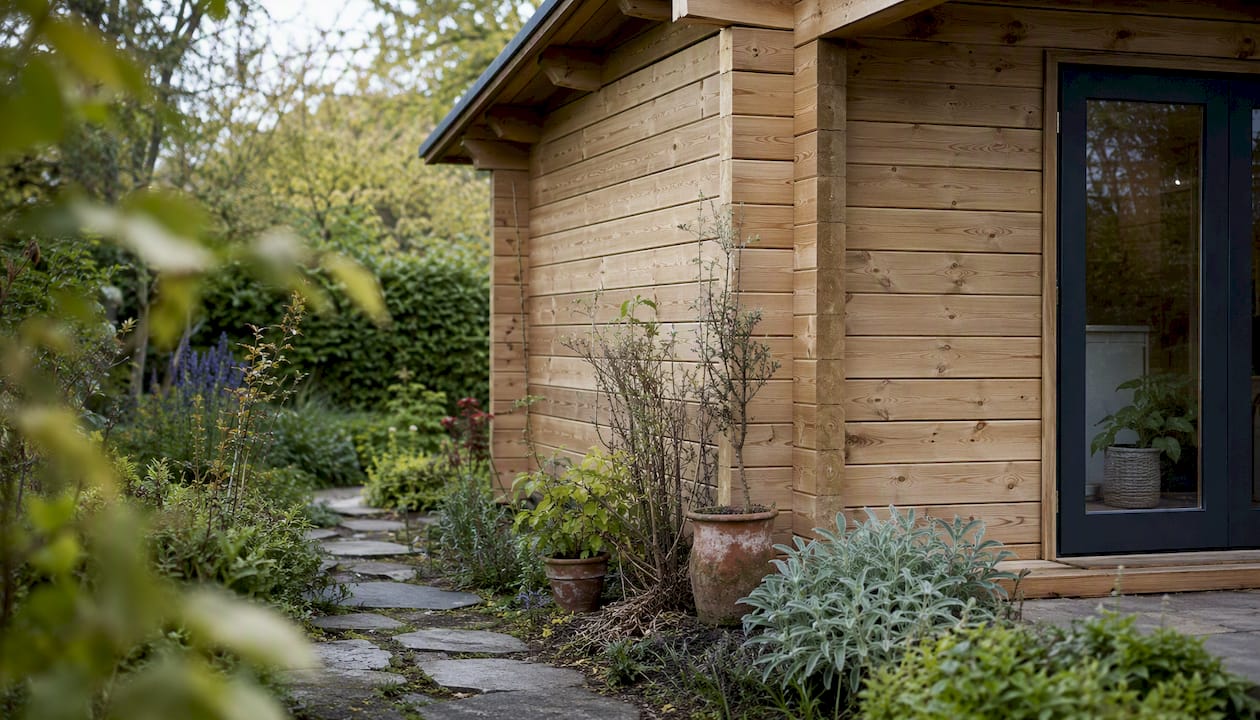
For timber garden buildings, the relevant fire-performance questions centre on three areas: surface spread of flame on external cladding and internal linings, reaction to fire of roof coverings, and, where relevant, the resistance performance of any separating elements such as doors or glazed screens.
For garden log cabins, the most practical checklist looks like this:
- External cladding: ask for EN 13501-1 reaction-to-fire classification (now required; BS 476 Part 7 no longer acceptable for new specifications)
- Roof covering: EN 13501-5 (BROOF classification) for external fire exposure, replacing BS 476 Part 3
- Internal linings: EN 13501-1 class for any plasterboard, timber boarding, or insulation used inside the cabin
- Doors and glazed screens: if a fire-rated doorset is specified, ask for BS EN 1634-1 test evidence and EN 13501-2 classification
- Insulation: check reaction-to-fire class; Rockwool and fibreglass insulation have different fire-performance profiles worth comparing
For bespoke cabins where cladding, roofing, or internal finishes differ from a standard range, the fire-performance evidence must match the actual specification. A test certificate for a standard product does not cover a modified assembly. Our fire safety guide for garden cabins covers the practical steps in more detail.
Pro Tip: For bespoke or non-standard cabin specifications, ask your supplier to confirm in writing which specific products have been tested and to which standard. If they cannot provide this, treat it as a gap that needs resolving before the build proceeds.
How BS 476 compares with fire rating systems used internationally
Beyond the EN system, other countries use their own fire rating frameworks. In the United States, ASTM E119 is the primary fire-resistance test for building assemblies, and UL (Underwriters Laboratories) listings are widely referenced. In Australia, AS 1530 covers reaction-to-fire testing, with AS 4072 for components used in fire-resistance systems.
The classification language differs significantly. US ratings use hours (a “one-hour rated assembly”), while EN uses minutes with letter codes (EI 60). Australian classes use a numerical index system for ignitability, spread of flame, heat evolved, and smoke developed.
None of these systems are directly interchangeable with BS 476 or with EN 13501. A product with a UL listing or an AS 1530 result needs separate EN testing to be specified on a UK project. This matters for imported products, particularly cladding systems, glazing, and door assemblies sourced from outside Europe.
Where BS 476 tests fall short compared with modern standards
The older BS 476 methods have attracted criticism on several fronts. Parts 6 and 7, the surface spread tests, used relatively small specimens and a fixed gas flame that does not replicate the heat flux of a real building fire. Critics argued the tests allowed some materials to achieve good national classes in the lab while performing poorly in real fire conditions.
The Grenfell Tower fire in 2017 brought these limitations into sharp focus. The subsequent inquiry and Dame Judith Hackitt’s independent review both highlighted weaknesses in how fire performance was tested, classified, and specified across the industry. While BS 476 was not the only factor, the inadequacy of some older test methods for complex cladding systems was a significant finding.
EN test methods address some of these gaps. EN 13501-1 uses the SBI (Single Burning Item) test, which exposes specimens to a larger, more realistic flame source and measures heat release rate alongside flame spread. This gives a more meaningful picture of how a material will behave in an actual fire scenario.
What materials and products are commonly tested under BS 476?
BS 476 has been applied to a very wide range of products over the decades. The most common categories include:
- Fire doors and doorsets: tested to Part 22 for integrity and insulation, typically at 30 or 60 minutes
- Partitions and wall panels: tested to Part 22 for non-loadbearing resistance
- Structural elements: beams, columns, and floors tested to Part 21 for loadbearing resistance
- Ceiling and wall linings: tested to Parts 6 and 7 for surface spread of flame (now withdrawn; EN 13501-1 required)
- Roof coverings: tested to Part 3 for external fire exposure (now replaced by EN 13501-5)
- Ventilation ducts: tested to Part 24 for fire resistance
- Intumescent seals and strips: tested as components contributing to doorset or partition performance
Timber products appear across most of these categories. Untreated softwood typically achieves Class 3 or Class 4 under the old Part 7 test. Treated or modified timber, or timber with a fire-retardant coating, can reach Class 1 or Class 0. Under EN 13501-1, equivalent classes run from D (typical untreated softwood) up to B or A2 for treated products.
BS 476 ratings in procurement and legal disputes
In procurement, a BS 476 certificate is still acceptable evidence for fire-resistance properties until September 2029, provided the project falls within the transitional provisions. For reaction-to-fire properties, EN 13501-1 evidence is already required for new specifications from March 2025.
In legal disputes and insurance claims, the picture is more complicated. Courts and loss adjusters look at what was required at the time of specification and whether the product met that requirement. A product correctly specified and tested to BS 476 before the relevant withdrawal date is generally defensible. A product specified after the withdrawal date using only legacy BS 476 evidence is not.
The BBA’s advice is clear: manufacturers and specifiers who rely solely on BS 476 data face certification and compliance risks as the transition completes. Proactively obtaining EN evidence is the safest commercial and legal position.
For procurement teams, the practical rule is straightforward: request EN evidence for all new specifications now, and treat any product that cannot supply it as a risk that needs managing before contract award.
A practical note on specifying fire performance for garden buildings
Specifying fire performance for a timber garden building does not need to be complicated, but it does need to be done properly. The shift from BS 476 to EN standards is the right move: the EN methods give a clearer, more consistent picture of how materials actually behave in fire, and they remove the confusion of running two parallel systems.
For bespoke or non-standard cabins, the specification conversation needs to happen early, before materials are ordered and before the build starts. Asking the right questions at the design stage is far easier than chasing certificates after the structure is up.
Bespoke garden log cabins built with your specification in mind

If you are specifying a garden building and want to make sure the materials and construction match your fire-safety requirements, Logcabinkits offers a range of bespoke garden log cabins that can be adjusted to meet specific cladding, roofing, lining, and glazing requirements. Whether you need a particular wall thickness, a specific door configuration, or confirmation of the materials used in your build, the team can work through the details with you.
Browse the full garden log cabin range or use the cabin selection wizard to find a starting point, then get in touch to discuss any bespoke adjustments or specification queries. Delivery is available across the UK mainland.
Sources
- Amendments to Approved Document B: fire safety — new updates to support enhanced fire safety
- The changing status of the BS 476 standard series
- Part B changes being phased in to improve fire safety | RICS