
TL;DR:
- A U-value measures how quickly heat passes through building materials, with lower values indicating better insulation. Proper insulation, airtightness, and moisture control are essential to minimize heat loss and ensure cabin comfort, especially with 2026 UK regulations targeting specific U-values. The roof typically offers the most significant opportunity for heat retention improvements in timber cabins.
A U-value is a measure of how quickly heat passes through a building material, expressed in watts per square metre per kelvin (W/m²K). The lower the U-value, the better the insulation. If you’re planning a garden cabin or upgrading an existing one, understanding what are U-values in cabins is the single most useful thing you can do before spending a penny on insulation.
What are U-values in cabins and why do they matter?
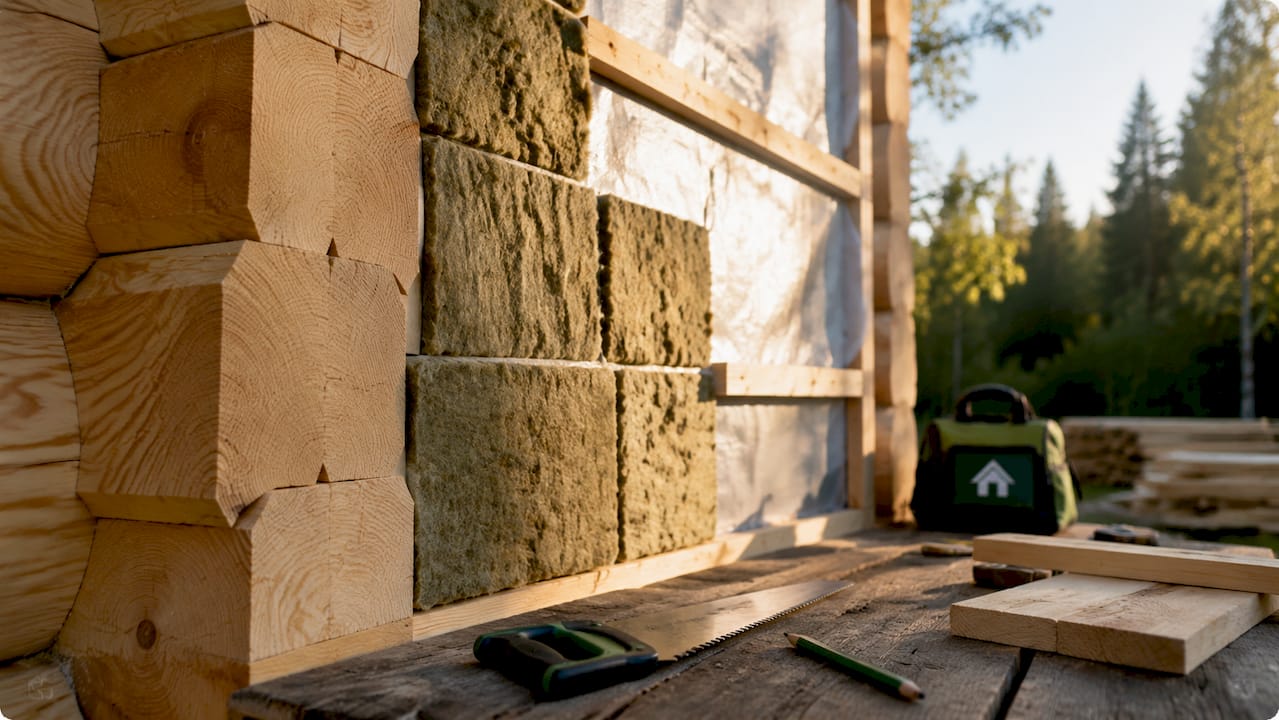
A U-value tells you the rate of heat transfer through a wall, roof, or floor. A cabin wall with a U-value of 0.8 W/m²K loses heat roughly four times faster than one rated at 0.2 W/m²K. That difference shows up directly on your heating bill and in how comfortable the cabin feels on a cold january morning.
The technical term for this measurement is thermal transmittance. You’ll hear both terms used interchangeably, but thermal transmittance is the recognised industry standard. U-value is simply the shorthand version that builders, architects, and homeowners all use in practice.
For cabins specifically, U-values matter more than you might expect. Timber structures have thinner envelopes than brick houses, and many standard garden log cabins are sold without any insulation at all. That means the gap between a poorly specified cabin and a well-insulated one is enormous, both in comfort and running costs.
How are U-values calculated for cabin walls, roofs, and floors?
The formula is straightforward: U = 1 ÷ ΣR, where ΣR is the total thermal resistance of all the layers in a wall, roof, or floor. Each layer adds resistance based on its thickness and its thermal conductivity (called lambda, measured in W/mK). Thicker layers and materials with a lower lambda value both reduce the U-value.
The step-by-step calculation
- List every layer in the construction (for example: external cladding, insulation, internal lining).
- For each layer, divide its thickness in metres by its lambda value. This gives you the thermal resistance ® of that layer.
- Add fixed surface resistances: 0.13 m²K/W for the internal surface and 0.04 m²K/W for the external surface.
- Add all R values together to get ΣR.
- Divide 1 by ΣR to get the U-value.
Example calculation for a simple cabin wall
| Layer | Thickness (m) | Lambda (W/mK) | R value (m²K/W) |
|---|---|---|---|
| External surface resistance | — | — | 0.04 |
| Timber log wall (100mm) | 0.10 | 0.13 | 0.77 |
| Mineral wool insulation (100mm) | 0.10 | 0.038 | 2.63 |
| Internal plasterboard (12.5mm) | 0.0125 | 0.25 | 0.05 |
| Internal surface resistance | — | — | 0.13 |
| Total ΣR | 3.62 | ||
| U-value (1 ÷ 3.62) | 0.28 W/m²K |
This example shows how adding 100mm of mineral wool to a timber log wall brings the U-value down to a respectable 0.28 W/m²K. Without the insulation layer, the same wall would sit closer to 0.8 W/m²K.
Pro Tip: When comparing insulation products, always check the declared lambda value on the product certificate. PIR boards typically have a lambda of around 0.022–0.023 W/mK, which means you need less thickness than mineral wool to achieve the same U-value.
What U-value targets apply to UK cabins in 2026?
Approved Document L (2026) sets the maximum U-values for new UK dwellings. The key figures are:
- External walls: 0.18 W/m²K (notional target); 0.26 W/m²K (limiting maximum)
- Roofs: 0.13 W/m²K (notional target); 0.20 W/m²K (limiting maximum)
- Ground floors: 0.13 W/m²K (notional target); 0.25 W/m²K (limiting maximum)
The notional value is what the regulations assume in their energy modelling. The limiting value is the absolute worst you are allowed to build. Compliance uses SAP 10.3 methodology, which looks at whole-building energy performance rather than individual elements in isolation.
Do these regulations apply to garden log cabins?
This is where it gets practical. If your cabin is a habitable room or a permanent dwelling, Building Regulations apply in full. If it’s a garden office or leisure cabin under a certain size and not used as sleeping accommodation, permitted development rules may mean you’re not legally required to meet these targets. That said, meeting them is still worth doing. A cabin that hits 0.18 W/m²K on walls and 0.13 W/m²K on the roof will cost far less to heat and will be genuinely comfortable year-round.
For replacement elements in an existing cabin, the limiting U-values for renovations are slightly more relaxed, but the direction of travel is clear. UK regulations are tightening, and building to the notional values now future-proofs your investment.
Key figures to remember: 0.18 W/m²K for walls, 0.13 W/m²K for roofs. These are the 2026 notional targets for new builds in England.
How do U-values affect cabin comfort and energy costs?
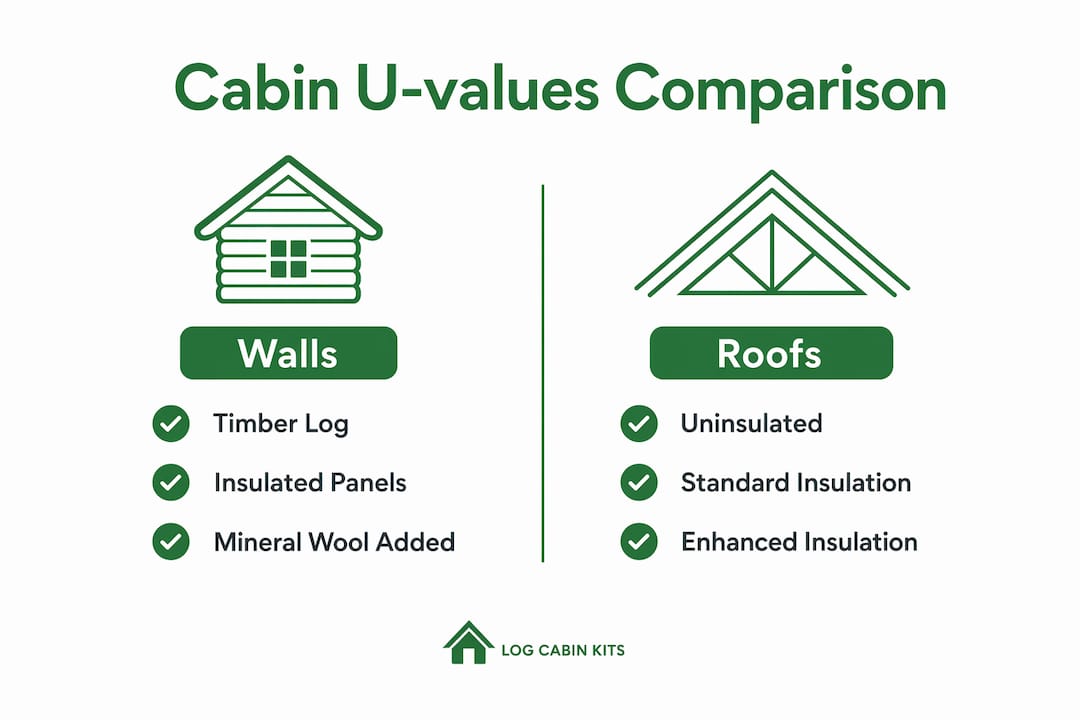
The impact of U-values on a cabin’s running costs is significant. An uninsulated log cabin can have wall U-values around 0.8 W/m²K and roof U-values of 2.0 W/m²K or worse. Adding around 100mm of mineral wool can bring wall U-values down to roughly 0.25 W/m²K and roof U-values to under 0.2 W/m²K. That’s a dramatic reduction in heat loss.
Here’s what that means in practice:
- A cabin with a roof U-value of 2.0 W/m²K loses heat through the ceiling at roughly ten times the rate of one with a 0.2 W/m²K roof.
- Lower U-values mean your electric heater or log burner works less hard to maintain a comfortable temperature.
- Better insulation reduces condensation risk, which protects the timber structure over the long term.
- A well-insulated cabin stays cooler in summer too, because insulation works both ways.
Roof insulation is the single highest-priority upgrade for most cabins. Heat rises, and an uninsulated roof is the biggest source of heat loss in a typical timber structure. If you can only insulate one element, start there.
Pro Tip: When specifying insulation, always check the product certificate for the declared U-value alongside the insulation thickness and lambda value. A certificate gives you the verified figure, not just a manufacturer’s estimate.
Understanding how wall thickness affects U-values is also worth your time before you finalise a cabin specification.
What else affects U-value performance in real cabins?
U-values give you a reliable picture of heat loss through a flat, uninterrupted section of wall or roof. Real cabins are more complicated. Several factors can make actual heat loss worse than the calculated U-value suggests.
Thermal bridging
Thermal bridging occurs at junctions, fixings, and penetrations where heat bypasses the insulation layer. A timber stud running through a wall, or a roof joist touching the external cladding, creates a path of higher conductivity. This increases real heat loss beyond what the nominal U-value predicts. Continuous insulation strategies, where the insulation layer wraps without interruption, are the most effective way to limit this.
Airtightness
Airtightness and thermal bridges must be considered alongside U-values to achieve effective whole-cabin energy efficiency. Even a cabin with excellent U-values will lose heat rapidly if there are gaps around windows, doors, or where the wall meets the floor. Air leakage carries warm, moist air out of the cabin and cold air in. The result is draughts, higher heating costs, and potential moisture damage to the timber frame. Understanding why cabins need air gaps in the right places (and sealed gaps in the wrong ones) is part of getting this right.
Timber’s own thermal resistance
Timber log walls contribute their own thermal resistance to the overall U-value calculation. A 100mm log wall has an R-value of around 0.77 m²K/W, which is a meaningful contribution. This makes cabin wall calculations different from masonry construction, where the block itself adds very little resistance. You’re building up total resistance from the timber layer outward, not just adding insulation to a structural shell.
Moisture management
Insulation choice must be paired with moisture control. PIR boards offer excellent thermal performance but are vapour-impermeable, which can trap moisture in a timber structure if not detailed correctly. Mineral wool is vapour-permeable but needs protection from liquid water. Getting this wrong causes condensation, timber decay, and a loss of insulation performance over time. Always pair your U-value strategy with a clear vapour control approach.
Key takeaways
A cabin’s U-value is the single most reliable indicator of how well it retains heat, but achieving low real-world heat loss requires continuous insulation, good airtightness, and proper moisture management working together.
| Point | Details |
|---|---|
| U-value definition | U-value measures heat transfer in W/m²K; lower values mean better insulation performance. |
| 2026 UK targets | Approved Document L sets 0.18 W/m²K for walls and 0.13 W/m²K for roofs in new builds. |
| Roof first | Roof insulation delivers the largest reduction in heat loss for most uninsulated cabins. |
| Thermal bridging | Junctions and fixings increase real heat loss beyond nominal U-values; continuous insulation limits this. |
| Moisture matters | Insulation type must suit the timber structure; vapour control is as important as thermal performance. |
Why I always tell people to start with the roof
I’ve spoken to a lot of cabin owners who’ve spent money insulating walls first because it felt like the obvious thing to do. The walls are what you see. They’re what you touch when it’s cold. But the roof is almost always where the real heat is going.
An uninsulated cabin roof sitting at 2.0 W/m²K is haemorrhaging heat. You can do everything else right and still end up with a cold, expensive-to-run cabin if the ceiling is left bare. I’d always recommend tackling the roof before anything else, even if it means delaying the wall insulation for a season.
The other thing I’d push back on is the idea that hitting a target U-value means the job is done. I’ve seen beautifully specified cabins with excellent U-values on paper that were still cold and draughty because the builder hadn’t addressed the junctions properly. Thermal bridging at the wall-to-floor junction or around window frames can undo a lot of good insulation work. The U-value of the flat wall section is only part of the story.
My honest advice: choose double skin construction if you want year-round comfort without compromise, get certified U-values from your insulation supplier in writing, and talk to a building professional before you finalise the specification. It’s not complicated once you know what to ask for.
— Martin
Logcabinkits cabins built with insulation in mind
If you’re planning a cabin that actually stays warm in winter, Logcabinkits has a range worth looking at.

The fully insulated cabin kits are designed with certified U-values for walls and roofs, so you’re not guessing at performance. If you need something tailored to a specific site or insulation specification, the bespoke cabin design service lets you build to your exact requirements. And if you’re still at the browsing stage, the full garden log cabins range covers everything from compact garden offices to larger multi-room buildings. Every cabin in the range can be specified with insulation upgrades to meet 2026 standards.
FAQ
What is a U-value in simple terms?
A U-value measures how fast heat passes through a wall, roof, or floor. The lower the number, the better the insulation.
What U-value should a cabin wall have in the UK?
Approved Document L (2026) sets a notional target of 0.18 W/m²K for external walls in new builds. Aiming for this figure gives you a well-insulated, energy-efficient cabin.
How do I improve the U-value of my cabin?
Adding insulation is the most effective method. Around 100mm of mineral wool can reduce a typical uninsulated log cabin wall from 0.8 W/m²K to roughly 0.25 W/m²K. The step-by-step insulation guide from Logcabinkits covers the process in detail.
Does timber have a U-value of its own?
Timber contributes its own thermal resistance to the overall U-value calculation. A 100mm log wall has an R-value of around 0.77 m²K/W, which forms part of the total resistance before any additional insulation is added.
Are U-values the only thing that matters for cabin insulation?
No. Airtightness and thermal bridging both affect real heat loss beyond what U-values alone predict. A cabin needs good insulation, sealed junctions, and proper moisture management to perform well in practice.
Recommended
- Why Cabins Add Property Value: A 2026 Guide
- blog what is a pod cabin your 2026 guide explained | Specialist Garden Cabin Supplier
- blog why cabins need air gaps your complete guide | Specialist Garden Cabin Supplier
- blog what is double glazing in cabins your full guide | Specialist Garden Cabin Supplier