
A well-insulated 10 to 12m² garden room heated for around four hours a day across a five-month winter season typically costs somewhere between £150 and £200 in electricity. A poorly insulated room of the same size can cost substantially more over the same period, often two to three times as much for the same comfort. The single biggest factor isn’t the heater you buy. It’s how well the building holds onto heat in the first place, so insulation and simple controls like a thermostat and timer matter more than heater brand or type.
TL;DR:
- Insulation quality has the biggest impact on heating costs, with well-insulated rooms costing roughly £150 to £200 for a five-month winter season.
- Air-to-air heat pumps with high COPs can significantly reduce seasonal costs compared to electric heaters, often bringing bills closer to £60 to £65.
- Proper sizing and controls, such as thermostats and timers, are essential to avoid energy waste and ensure consistent warmth in the garden room.
- Insulation standards, including low U-values for walls, roof, and floor, are far more crucial than the choice of heater for long-term savings.
- Spending on insulation and airtightness upgrades outweighs investing in fancier heaters or features for reducing winter heating costs.
Table of Contents
- What are the best heating options for a garden room?
- How much does it actually cost to heat a garden room?
- Why does insulation matter more than the heater you choose?
- How do you size a heater correctly for a garden room?
- What daily habits actually lower your heating bill?
- What checklist should you use before buying a garden room?
- Where should you put your money: insulation or a fancier heater?
- Get a garden room built to keep running costs down
- Sources
- FAQ
What are the best heating options for a garden room?
Choosing a heater is where most people start, but it’s the second decision, not the first. Once your garden room is properly insulated, the heater choice becomes about comfort and convenience rather than desperately trying to plug a leaky building.
Here’s how the main options stack up for a typical 10 to 15m² room:
- Electric panel heaters and modern electric radiators: usually 1kW to 1.5kW for this size room, simple to install and pair with accurate thermostats. Running costs are higher than a heat pump, but they’re cheap to buy and need no professional fitting.
- Infrared panels: typically 400W to 700W, and one of the most cost-effective choices for anyone who sits at a desk for a few hours rather than heating the whole room. Infrared warms you and your furniture directly rather than the air around you, which is why it works so well for intermittent use.
- Oil-filled radiators and portable fan heaters: low upfront cost, but they tend to be the most expensive to run all day. Better as a backup for a cold snap than your main heat source.
- Underfloor electric heating: comfortable and unobtrusive for a garden room used daily, but it needs the right floor build from day one and costs more to install.
- Air-to-air heat pumps (mini-splits): installation typically runs £1,500 to £2,500), noticeably more than a plug-in heater, but a coefficient of performance around 2 to 3 means they can cut your seasonal running cost substantially. You get summer cooling as a bonus too.
- Wood or bioethanol stoves: a lovely look and feel, but they bring flue work, safety requirements and more complex installation. Fuel costs vary a lot depending on what you burn and how often.
For most garden offices, a mix works best: a background panel heater or heat pump to keep the room at a steady temperature, with an infrared panel over the desk for quick top-up warmth.
How much does it actually cost to heat a garden room?
The maths behind heating costs isn’t complicated. It’s kilowatts multiplied by hours used, multiplied by your pence-per-kWh rate. Get those three numbers and you can work out almost any scenario yourself.
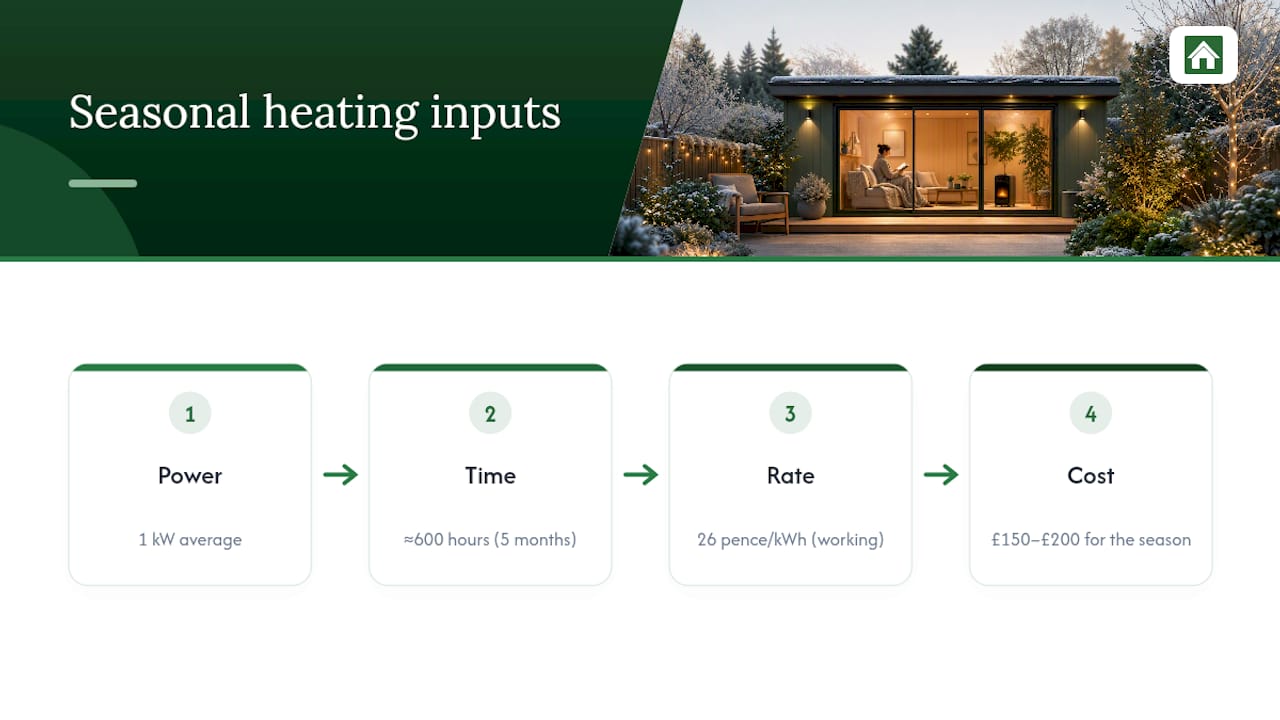
Formula: kW × hours × pence per kWh = cost
Check your current unit rate against the Ofgem price cap, which has hovered around the mid-20s in pence per kWh through 2026 but changes every quarter. The examples below use 26p/kWh as a working figure, so swap in your own rate for an accurate number.
Worked examples across a typical five-month heating season (roughly 600 hours of use)
- Well-insulated 12m² room: averaging 1kW draw for 4 hours a day gives around 600 kWh for the season, which comes to roughly £150 to £200 at 25 to 26p/kWh.
- Poorly insulated room, same size: averaging 2kW over the same hours gives around 1,200 kWh, pushing the cost to £300 or more, two to three times higher than the insulated version.
- Heat pump scenario: with a COP of 2.5, that same heat output needs roughly 240 kWh of electricity input rather than 600, bringing the seasonal cost down closer to £60 to £65 before installation costs are factored in.
For a quick sanity check on smaller numbers, a 1,000W heater running at around 27.69p/kWh costs roughly £0.28 an hour, so four hours a day works out to around £1.10 daily. These figures ignore standing charges and assume a flat tariff. Your actual bill will shift with regional pricing and whichever tariff you’re on, so always plug in your own rate before making a buying decision.
Why does insulation matter more than the heater you choose?
Here’s the honest truth: you can buy the most efficient heat pump on the market and still have high bills if the room itself is leaking heat through the walls, roof and floor. The building’s fabric decides how much energy you need in the first place. The heater just decides how you deliver it.
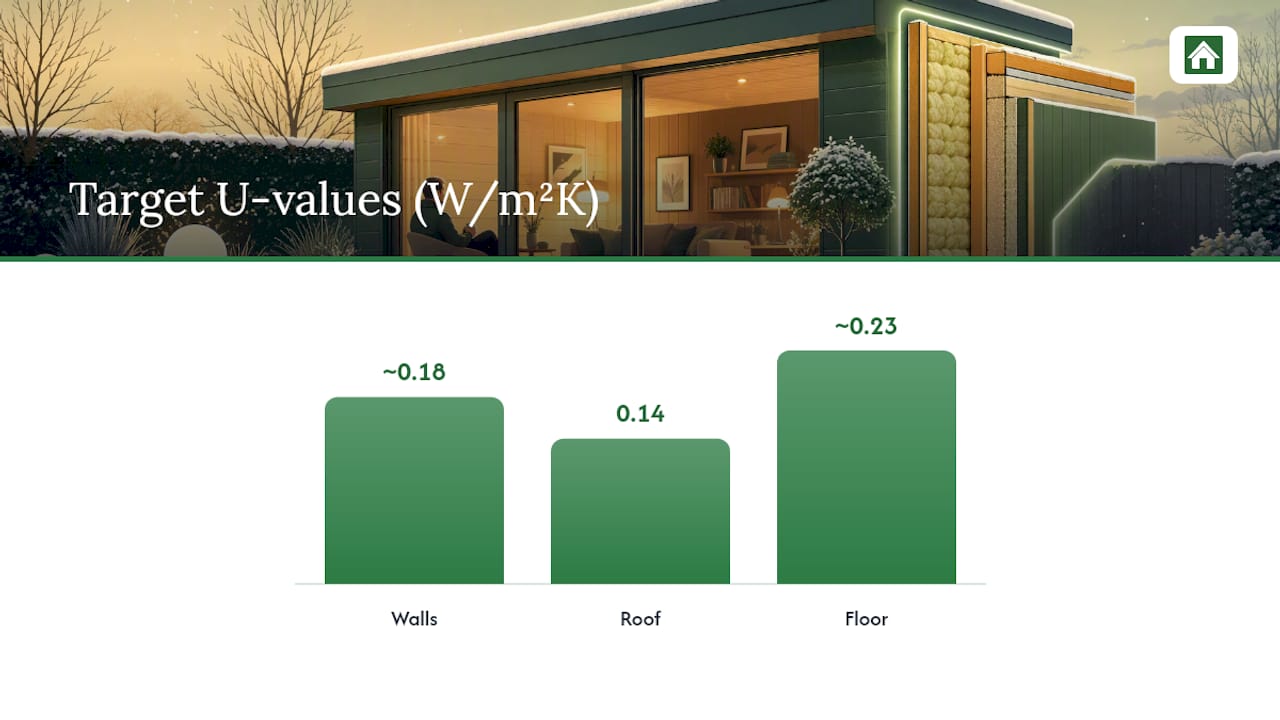
U-values measure how much heat escapes through a material, and lower numbers mean better insulation. For a garden room you want to use all year round, aim for these targets:
- Walls around 0.18 W/m²K
- Roof between 0.12 and 0.16 W/m²K
- Floor roughly 0.20 to 0.25 W/m²K
- Glazing: argon-filled, Low-E double glazing with a warm-edge spacer
In practical terms, that usually means PIR or phenolic insulation boards fitted at 70 to 100mm in the walls, 100 to 150mm in the roof, and around 100mm in the floor. Airtightness matters just as much as the boards themselves. A vapour control layer with properly taped joints stops warm, moist air escaping into the timber structure, which protects both your heating bills and the building’s long-term health. Our guide to garden room U-values breaks this down room by room if you want the fuller picture.
Pro Tip: Ask any supplier for written U-values before you buy, not vague terms like “fully insulated”. Two rooms that look identical from the outside can perform very differently once winter arrives.
Most garden rooms used as offices or hobby spaces sit outside full Building Regulations control, but Part L guidance still applies as good practice for insulation standards, and compliance becomes compulsory if the building includes sleeping accommodation or crosses certain size thresholds. Meeting those Part L standards protects your running costs for decades and matters at resale too, since buyers increasingly ask about insulation specs before viewing.
How do you size a heater correctly for a garden room?
Getting the wattage right avoids two expensive mistakes: buying a heater that never quite warms the room, or one so oversized it wastes energy cycling on and off.
- Work out your rough wattage need. A well-insulated room typically needs 50 to 75 watts per square metre, while a poorly built shell can demand 100 watts per square metre or more. Treat these as starting ranges rather than exact figures, since draughts and ceiling height both shift the number.
- Split larger rooms across multiple heaters rather than relying on one big unit. Two moderate heaters spread heat more evenly and let you turn one off when only part of the room is in use.
- Insist on decent controls. A proper thermostat, a programmable timer, and ideally open-window detection or smart scheduling will cut your running cost more than any heater upgrade. If you’re heating more than one zone, thermostatic radiator valves let you set different temperatures room by room.
- Ask your supplier the right questions. Get a written U-value specification, proof of electrician certification for any hardwired install, and their suggested setpoints with an estimated seasonal kWh figure. A supplier who can’t answer these hasn’t thought hard enough about your running costs.
What daily habits actually lower your heating bill?
Small changes add up faster than most people expect, and none of them cost anything to put into practice.
- Use a timer to pre-heat, rather than letting the room go cold and blasting the heater when you arrive. Reheating from cold uses more energy than maintaining a steady, lower background temperature.
- Zone your heating: an infrared panel over the desk for direct warmth, paired with a background panel heater on a low setting to keep the whole room comfortable.
- Check seals and glazing each autumn, and service any heat pump filters annually so the unit isn’t working harder than it needs to.
- Get your electrical supply checked if you’re adding a heat pump or underfloor heating. Undersized breakers or cabling can limit what you can safely run.
Heating an empty room is one of the most common causes of wasted energy and inflated bills, so a timer that switches off when nobody’s using the space pays for itself within weeks.
What checklist should you use before buying a garden room?
A few specification details separate a garden room that’s cheap to heat from one that quietly drains money every winter, and most of them are invisible once the building is finished.
Before you commit, request written U-values for walls, roof and floor, photos of the taped vapour control layer during construction, and a clear glazing specification. Ask to see the electrical supply drawing too, since hidden costs like an electrics upgrade, trenching for a new supply cable, or flue works for a stove often appear late in a quote and catch buyers by surprise. Our guides on insulation and building efficiency and winter garden room use go into more detail on spotting these traps early.
Where should you put your money: insulation or a fancier heater?
If you’re weighing up whether to spend extra on insulation or on a more expensive heater, spend it on insulation and controls first. A cheap heater in a well-built room will always beat an expensive heater in a leaky one, and the fabric of the building is far harder to upgrade later than the heater plugged into it.
My practical nudge for anyone building or buying: document the build stages as you go, photos of insulation boards, taped joints, glazing specs. It protects you if something underperforms, and it’s a genuine selling point if you ever move.
— Martin
Get a garden room built to keep running costs down
They build bespoke garden log cabins, garden offices and multi-room buildings with factory-fitted insulation and double glazing as options, helping you understand U-values after the build is finished. Cabins are designed to customer specifications rather than picked from a generic catalogue, allowing choice in wall thickness, glazing and insulation details to suit intended use, such as a summer retreat or a room heated all winter.

Before you order, ask us for written U-value specifications and installation advice so you know exactly what you’re heating before the first bill arrives. Browse the full range of garden log cabins or start a bespoke build enquiry to get a properly specified, insulated garden room designed around your garden and your budget.
Sources
For the figures and standards referenced above, these sources are worth bookmarking: BestGardenRoom’s winter running cost guide, BestHeating’s garden room heating comparison, Designing Buildings’ insulated garden room guide, Homebuilding’s heating guide, and BuildingRegsPlans on Part L. Always check the current Ofgem price cap before relying on any pence-per-kWh figure for your own calculations.
- How much does a garden room cost to run in winter? — BestGardenRoom
- Our best heating options for garden rooms and outdoor offices — BestHeating
FAQ
What is the cheapest way to heat a garden room?
Infrared panels are usually the cheapest option for intermittent desk use, since they heat you directly rather than the whole room’s air. For all-day use in a well-insulated room, an air-to-air heat pump often works out cheaper to run despite higher upfront installation costs of £1,500 to £2,500.
What is the typical cost of a fully insulated garden room in the UK?
Running costs, rather than build costs, for a well-insulated 10 to 12m² room heated four hours a day across winter typically land between £150 and £200 for the whole season. A poorly insulated equivalent can cost two to three times as much for the same comfort level.
How do I keep a garden room warm in winter?
Prioritise good insulation with U-values around 0.18 W/m²K for walls, a taped vapour control layer for airtightness, and Low-E double glazing. Layer this with a heater sized to your room and a programmable thermostat, since pre-heating on a timer avoids the wasted energy of reheating from cold.
What is the best type of heater for a garden room?
There’s no single best type. It depends on how you use the room: infrared panels suit short desk sessions, panel heaters or heat pumps suit all-day occupation, and underfloor heating suits rooms used daily year-round. Bespoke builds from Logcabinkits’ garden offices range come with insulation and glazing specified to match whichever heating approach you plan to use.