
Garden room U-value: what you need to know

TL;DR:
- Understanding U-value is essential for creating a warm, energy-efficient garden room by accurately measuring heat loss through walls, roofs, and floors. Proper installation, avoiding thermal bridging and air leakage, and meeting UK regulations ensure optimal thermal performance and comfort year-round. Suppliers should provide verified U-values for each element, enabling informed decisions to minimize heating costs and improve usability.
If you’re planning a garden room and want it to be warm, comfortable, and cheap to heat, you’ll need to get your head around U-value. It’s one of those terms that gets thrown around a lot, but it’s rarely explained clearly. Understanding what is garden room U-value means going beyond just insulation thickness. The U-value tells you how well your walls, roof, and floor actually hold heat in. Get it right, and your garden room works all year round. Get it wrong, and you’ll be fighting cold spots and high heating bills from day one.
Table of Contents
- Key takeaways
- What is garden room U-value?
- Why thickness doesn’t tell the whole story
- UK building regulations and target U-values
- How to achieve good U-values in your build
- The real impact on heating and comfort
- Martin’s take: what I’ve actually seen in the real world
- Bespoke garden rooms built with real insulation performance
- FAQ
Key takeaways
| Point | Details |
|---|---|
| U-value measures heat loss | Lower U-values mean less heat escapes, giving you better comfort and lower running costs. |
| Thickness alone isn’t enough | Two garden rooms with the same insulation thickness can have very different U-values depending on build quality. |
| UK regulations set limits | Building Regulations set maximum U-values for walls, roofs, and floors that year-round garden rooms should meet or beat. |
| Whole assembly matters | U-value depends on every layer of your wall, roof, or floor, not just the insulation board. |
| Ask for verified figures | Always ask your supplier for U-value certificates for all elements, not just insulation specs. |
What is garden room U-value?
U-value stands for thermal transmittance. It measures how fast heat passes through a building element like a wall, roof, or floor. The unit is watts per square metre per kelvin (W/m²K). The lower the number, the slower heat moves through it. So a wall rated at 0.20 W/m²K holds heat far better than one rated at 0.60 W/m²K.
The U-value is calculated from the total thermal resistance of all the layers in a given element. This includes the insulation board, the timber frame, any cladding, membranes, and internal finishes. You can’t just look at the insulation alone. The overall U-value assessment includes every layer in the assembly, from the outside face to the inside face.
Here’s a quick reference for typical U-values you’ll encounter in garden room builds:
| Element | Basic build (W/m²K) | Good practice (W/m²K) | Target for year-round use (W/m²K) |
|---|---|---|---|
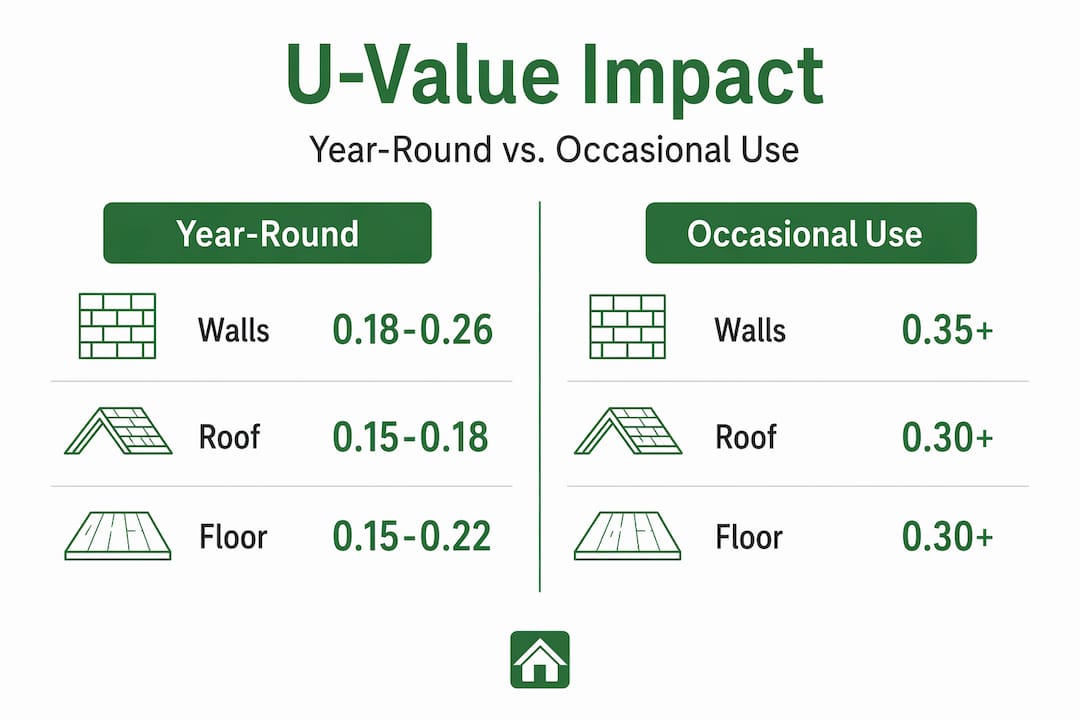
| Walls | 0.50 to 0.60 | 0.28 to 0.35 | 0.18 to 0.26 |
| Roof | 0.35 to 0.50 | 0.20 to 0.30 | 0.15 to 0.18 |
| Floor | 0.40 to 0.55 | 0.22 to 0.30 | 0.18 to 0.22 |
Pro Tip: When comparing garden room suppliers, ask them to provide U-values for each element separately: wall, roof, and floor. A single blanket claim like “fully insulated” tells you very little about actual thermal performance.
Why thickness doesn’t tell the whole story
This is where a lot of people get caught out. You might assume that the thicker the insulation, the better the U-value. And while thickness does matter, it’s not the full picture. Two garden rooms with the same insulation thickness can deliver very different U-values depending on how the whole assembly is designed and installed.
Here are the most common reasons why insulation thickness alone misleads you:
- Thermal bridging: Timber studs in the frame conduct heat far more readily than insulation. If the insulation only sits between studs and there’s no continuous layer covering them, the studs act as heat pathways. Thermal bridging at timber studs and fasteners can significantly degrade actual U-value performance.
- Air leakage: Gaps around boards, at junctions, and around fixings let warm air escape. This bypasses your insulation entirely and sends your real-world performance far below what the calculated U-value would suggest.
- No vapour control layer: A vapour control layer prevents moisture-laden air from getting into your insulation. Without it, insulation can become damp, which destroys its thermal effectiveness and can lead to mould.
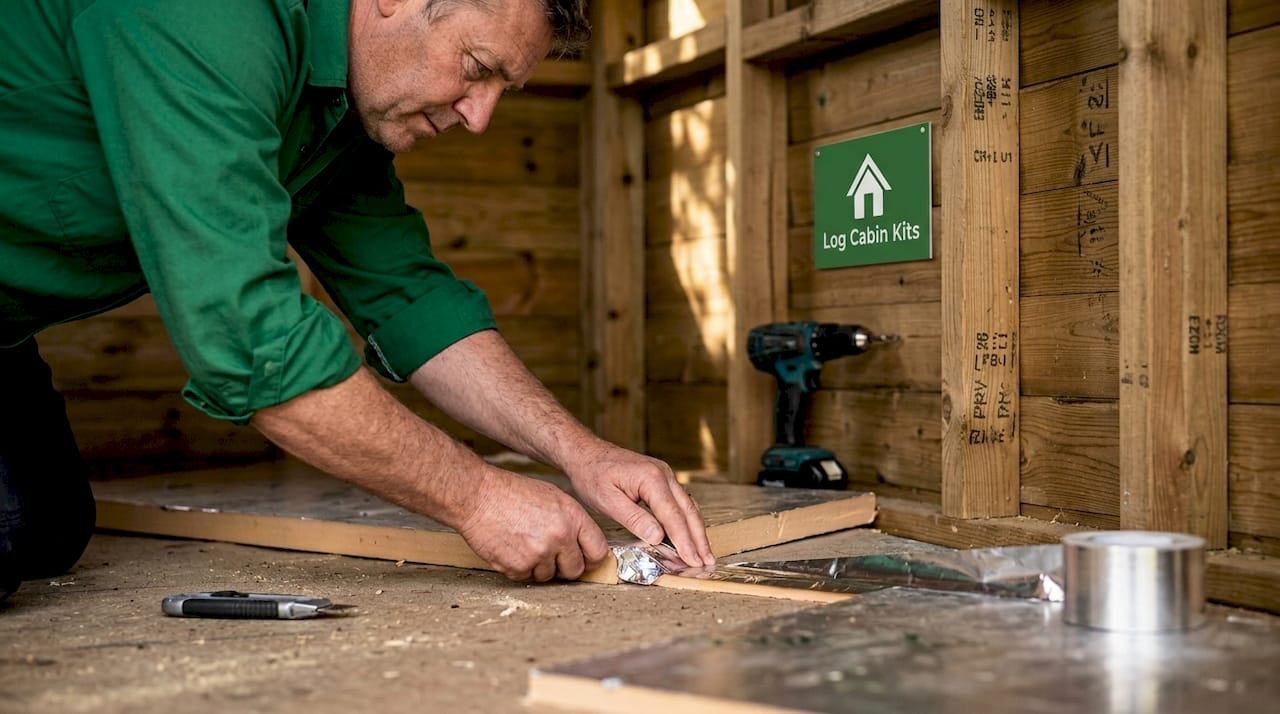
- Poor board fitting: Gaps between rigid insulation boards, even small ones, create cold bridges. Boards need to be cut accurately and joints taped.
- Ignoring junctions: Where walls meet floors, or roofs meet walls, the detailing matters. Poor junction design lets heat escape around the edges of otherwise well-insulated panels.
Pro Tip: If you’re doing a DIY build, invest in foil tape to seal every joint between PIR insulation boards. It’s inexpensive and makes a real difference to your effective U-value.
Airtightness and thermal bridging sit alongside U-value as equally important performance factors. Think of U-value as a leakiness score for heat through the material, but recognise that gaps and bridges create completely separate pathways for heat loss.
UK building regulations and target U-values
If you’re planning a garden room for year-round use, it’s worth knowing where the regulatory thresholds sit. UK Building Regulations Part L sets maximum U-values for new builds: walls must not exceed 0.26 W/m²K, roofs 0.16 W/m²K, and floors 0.18 W/m²K. Windows should be no worse than around 1.4 to 1.6 W/m²K.
Many garden rooms fall outside the scope of Building Regulations altogether, particularly smaller structures used occasionally. But if you want a garden room that’s genuinely comfortable to use in January, treating these limits as your minimum target is a sensible approach. Beating them, not just meeting them, is where real comfort begins.
| Element | Building regs maximum | Good practice target | Consequence of poor value |
|---|---|---|---|
| Walls | 0.26 W/m²K | 0.18 to 0.22 W/m²K | Cold walls, higher heating bills |
| Roof | 0.16 W/m²K | 0.13 to 0.16 W/m²K | Heat escapes rapidly overhead |
| Floor | 0.18 W/m²K | 0.15 to 0.18 W/m²K | Cold floor, heat loss upward |
| Windows | 1.6 W/m²K | 1.2 to 1.4 W/m²K | Condensation, cold draughts |
Building Regulations U-value standards have tightened steadily over the years, and 2026 standards continue to push towards better energy efficiency and lower carbon output. Even if your structure doesn’t require Building Regulations approval, these figures give you a clear benchmark to aim for.
For window choices that complement your insulation targets, take a look at window selection guidance for garden rooms. Windows are often the weakest point in an otherwise well-insulated build.
How to achieve good U-values in your build
Getting a low U-value isn’t complicated, but it does require making the right choices at every stage. Here’s a practical step-by-step approach:
-
Choose PIR rigid insulation boards. These offer the best thermal performance per millimetre of thickness. Achieving U-values of 0.18 to 0.25 W/m²K typically requires 75mm to 150mm of PIR depending on the element. For walls, 80mm is often a good starting point.
-
Add a continuous insulation layer. Where possible, add a layer of PIR across the face of your studs as well as between them. This breaks the thermal bridge through the timber and gives you a much more consistent U-value across the whole panel.
-
Fit your vapour control layer carefully. Lap the joins properly, tape all edges, and seal around any penetrations like cables or pipes. Vapour control layer quality directly affects long-term energy efficiency by stopping moisture from degrading the insulation.
-
Tape insulation board joints. Use foil-backed tape on all board edges. This removes air leakage paths and improves airtightness across the whole assembly.
-
Ask your supplier for U-value calculations. Suppliers quoting only insulation thickness are giving you incomplete information. A good supplier provides verified U-values for the full wall, roof, and floor assembly. If they can’t, that tells you something.
-
Think about wall thickness trade-offs. Garden rooms insulated with 80mm PIR achieve a good balance between cost, wall thickness, and thermal performance, typically reaching 0.18 to 0.30 W/m²K. Going to 100mm or 120mm improves this further but adds cost and reduces interior space slightly.
Pro Tip: For floors, use PIR boards between the floor joists and add an additional layer above the joists before fitting your floor deck. This simple addition dramatically improves your floor U-value without adding much height.
For a deeper dive into how insulation affects heat loss, there’s a detailed guide on the Logcabinkits blog worth reading before you finalise your spec.
The real impact on heating and comfort
Understanding U-value in theory is one thing. Knowing what it actually means to sit in your garden room on a cold February evening is another. A well-insulated garden room with U-values below 0.30 W/m²K saves on heating costs and maintains a stable temperature far more effectively than a poorly insulated one.
Here’s what better U-values actually deliver in practice:
- Lower running costs. Less heat escaping means your heater works less to maintain temperature. This adds up significantly over a winter.
- Faster warm-up times. A well-insulated room reaches your target temperature quickly. You’re not waiting 30 minutes for the chill to clear.
- No cold spots. Poor insulation in walls or floors creates uncomfortable cold zones that make the room feel colder than the air temperature suggests.
- Temperature stability overnight. Even when the heater switches off, a room with low U-values holds its warmth for longer.
- Better acoustics. Thicker, denser insulation also reduces sound transmission, which is a welcome bonus if you’re using the room as a home office or studio.
The energy efficiency gains from getting U-values right also pay off over the long term. The upfront cost of better insulation is recovered through lower energy bills, often within a few heating seasons.
Martin’s take: what I’ve actually seen in the real world
I’ve looked at a lot of garden room quotes over the years, and one pattern comes up again and again. A customer will show me a spec sheet that lists insulation thickness but gives no actual U-value figures. They’ve been told it’s “fully insulated” and assumed that means it’s warm. Often it isn’t.
What I’ve found is that the quality of the build, not just the materials, determines real-world performance. I’ve seen 100mm of insulation underperform 75mm because the thicker boards were poorly fitted, left gapped at edges, and had no vapour control. The numbers on paper meant nothing.
My honest advice: don’t chase a thickness figure. Ask your supplier for U-values per element and make sure those figures account for the full assembly, including the frame and any thermal bridging. A supplier who can’t or won’t provide that data is one to be cautious about.
The holistic approach to building performance matters more than any single spec. Get the design right, seal it properly, and you’ll have a garden room that’s genuinely pleasant to use all year long. That’s what it’s all about.
— Martin
Bespoke garden rooms built with real insulation performance
If you want a garden room with verified U-values and the flexibility to tailor insulation for your climate and usage, Logcabinkits has you covered. All bespoke builds come with clear specifications for wall, roof, and floor thermal performance. You’re not left guessing.

Our bespoke garden log cabins are designed with year-round comfort in mind. Every custom build comes with free UK delivery and the option to specify insulation levels that meet or exceed Building Regulations targets. If you want to discuss U-values, insulation thickness, or the best spec for your intended use, our team is happy to talk it through. No technical jargon, just practical guidance. You can also explore our custom build options to see how bespoke configurations work and get a tailored quote.
FAQ
What does U-value mean for a garden room?
U-value measures how quickly heat passes through a wall, roof, or floor, expressed in W/m²K. The lower the U-value, the better the thermal performance and the less heat your garden room loses.
What U-value should a garden room have for year-round use?
For comfortable year-round use, aim for walls at around 0.18 to 0.26 W/m²K, roofs at 0.15 to 0.18 W/m²K, and floors at 0.18 to 0.22 W/m²K. These figures align with or better UK Building Regulations limits.
Does thicker insulation always give a better U-value?
Not always. Installation quality, thermal bridging through timber studs, and air leakage all affect the real U-value. Two garden rooms with the same insulation thickness can perform very differently depending on how carefully they were built.
How do I check the U-value of a garden room I’m buying?
Ask the supplier for U-value calculations for the full wall, roof, and floor assemblies. A reliable supplier will provide verified figures, not just insulation thickness specifications.
Why does a vapour control layer affect U-value?
A vapour control layer prevents moisture from entering the insulation. Damp insulation loses much of its thermal effectiveness, which raises the effective U-value and increases heat loss over time.