Blog


TL;DR:
- Proper ventilation prevents damp, mould, and poor air quality in log cabins.
- Ventilation systems include passive, mechanical, and MVHR, chosen based on use and insulation.
- Good design and regular airflow improve cabin comfort, health, and protect your investment.
Many UK garden cabin owners assume that cracking a window now and then is all the ventilation they need. It’s an easy assumption to make, but it’s one that can lead to damp walls, musty smells, and air that leaves you feeling sluggish. Good ventilation isn’t just about fresh air. It’s about protecting your cabin, your health, and your investment. In this guide, we’ll walk you through why ventilation matters so much in log cabins, which systems work best, what the regulations say, and how to make practical improvements that you’ll notice straight away.
Table of Contents
- Why ventilation matters in log cabins
- Types of ventilation systems for garden cabins
- When is ventilation required by building regulations?
- Practical strategies for smarter cabin ventilation
- What most owners get wrong about cabin ventilation
- Elevate your cabin experience with expert designs
- Frequently asked questions
Key Takeaways
| Point | Details |
|---|---|
| Ventilation prevents damp | Good airflow avoids moisture buildup and mould in garden cabins. |
| Energy recovery boosts comfort | MVHR systems keep warm air in while refreshing indoor air efficiently. |
| Passive vs. mechanical options | Passive methods suit basic needs, but mechanical or MVHR excel in insulation and reliability. |
| Regulations differ by use | Sleeping cabins must meet legal standards, while others benefit from best practice guidelines. |
| Simple upgrades make a difference | Affordable actions like fans and regular window opening instantly improve air quality. |
Why ventilation matters in log cabins
Log cabins behave very differently from brick-built homes. Timber breathes, expands, and contracts with changes in temperature and humidity. That’s part of what makes it such a wonderful building material. But it also means that moisture management is critical. Without proper airflow, condensation builds up inside the walls and roof, often without you even noticing until the damage is done.
Poor ventilation can lead to damp, condensation, and uncomfortable air quality in log cabins. Damp timber warps, rots, and encourages mould growth. Mould isn’t just unsightly. It releases spores that can trigger allergies and respiratory problems, especially in children and older adults.
Air quality is another big concern. Research shows that CO2 under 1000ppm should be targeted indoors, and poor ventilation causes stagnation and allergens to build up. In a small, enclosed cabin, CO2 levels can rise quickly, leaving you feeling tired or headachy without knowing why.
Here’s what poor ventilation can cause in a garden cabin:
- Damp and mould on walls, floors, and furnishings
- Condensation on windows and cold surfaces
- Stale, stuffy air that reduces concentration and comfort
- Warped timber from moisture trapped in the structure
- Allergens including dust mites and mould spores
“Ventilation is one of the most overlooked aspects of log cabin ownership. Get it right from the start and you’ll avoid a long list of costly problems down the line.”
Understanding ventilation importance in cabins is the first step. The second is acting on it before problems appear, not after.
Pro Tip: If your cabin windows are regularly misting up on the inside, or you notice a musty smell when you open the door, those are early warning signs that your ventilation needs attention.
Types of ventilation systems for garden cabins
Now that you understand the why, it’s time to look at the options. There are three main approaches to ventilating a garden log cabin, and the right one for you depends on how you use your cabin, how well insulated it is, and your budget.
Passive ventilation uses natural airflow, mechanical uses extractor fans, and MVHR (Mechanical Ventilation with Heat Recovery) provides up to 95% heat recovery for airtight cabins. Each has its place.
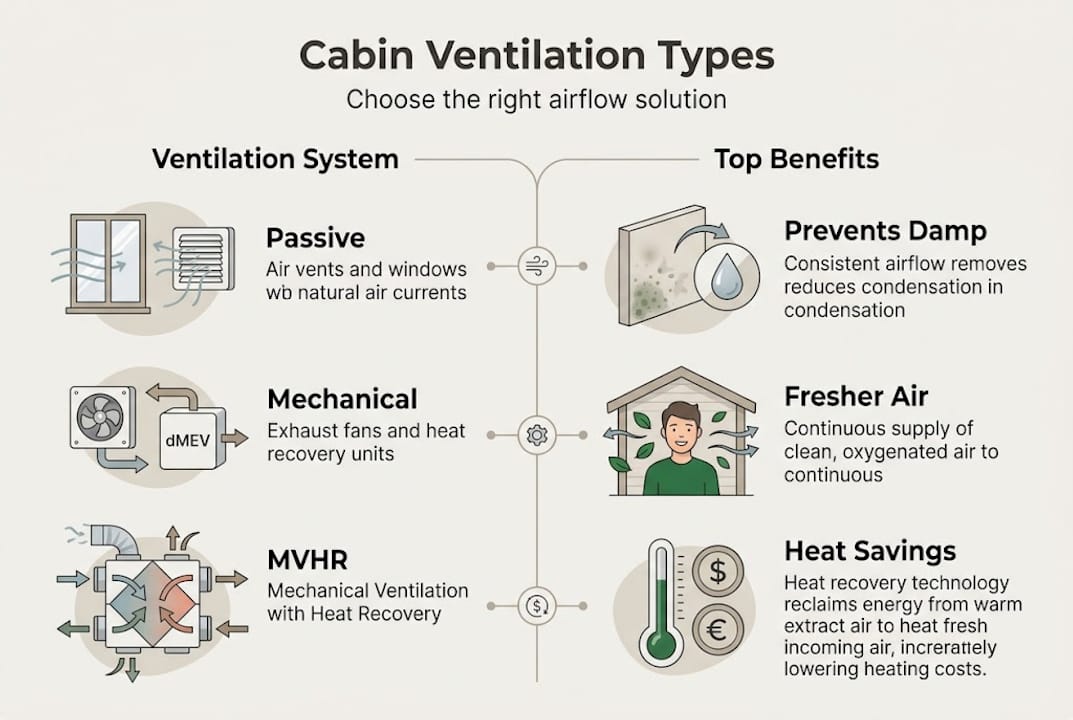
| System | How it works | Best for | Cost |
|---|---|---|---|
| Passive | Trickle vents, air bricks, open windows | Occasional use cabins | Low |
| Mechanical | Extractor fans, inline fans | Regular use, workshops | Medium |
| MVHR | Balanced supply and extract with heat recovery | Insulated, year-round cabins | Higher |
Choosing the right system doesn’t have to be complicated. Here’s a simple way to work it out:
- Assess how often you use the cabin. Occasional weekend use? Passive ventilation may be enough. Daily use as a home office or gym? You’ll want something more reliable.
- Consider how well insulated your cabin is. A heavily insulated, airtight cabin needs mechanical or MVHR ventilation to avoid stale air and moisture build-up.
- Think about the activities happening inside. Cooking, exercising, or working with tools all produce more moisture and CO2, so more active ventilation is wise.
- Factor in your budget. Passive systems are cheap to install but may need supplementing. MVHR costs more upfront but saves on heating bills over time.
Cross-ventilation is worth mentioning here. This means placing vents or openable windows on opposite sides of the cabin so air flows through naturally. It’s one of the simplest and most effective passive strategies available.
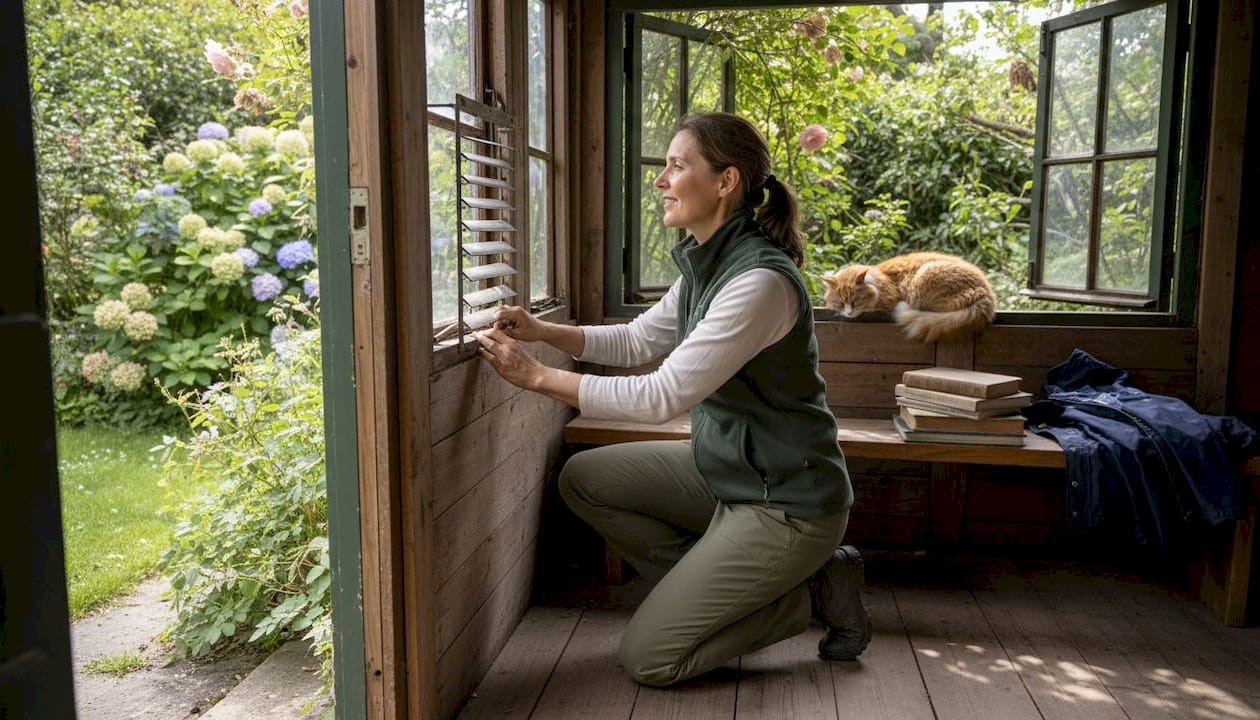
For more hands-on guidance, our article on practical ventilation solutions covers installation tips in more detail. If you’re also thinking about heating, pairing good ventilation with energy efficient heating makes a real difference to year-round comfort.
Pro Tip: Cross-ventilation works best when the inlet and outlet openings are at different heights. Warm, stale air rises, so a high-level vent on one side and a lower vent on the other creates a natural chimney effect.
When is ventilation required by building regulations?
Once you’ve chosen your approach, it’s sensible to check whether your cabin needs to meet any legal requirements. The rules depend on how your cabin is used.
UK Building Regulations (Part F) require ventilation for habitable or sleeping cabins, and it’s recommended for all cabins to prevent damp. Part F applies in England and Wales. Scotland has its own equivalent under Section 3 of the Technical Handbooks, which covers ventilation in a similar way.
Here’s a quick breakdown of where you stand:
| Cabin use | Regulations apply? | Our recommendation |
|---|---|---|
| Storage only | No | Basic passive vents |
| Home office | Advisable | Trickle vents and fan |
| Gym or studio | Advisable | Mechanical extraction |
| Sleeping or habitable | Yes | Full Part F compliance |
| Insulated year-round | Yes | MVHR or mechanical |
Even when regulations don’t strictly apply, ventilating your cabin properly is always the right call. Damp and mould don’t care about planning categories.
Here’s a simple checklist for most UK garden cabin owners:
- Trickle vents fitted to windows or frames
- At least one openable window per room or space
- Extractor fan if cooking, showering, or exercising inside
- MVHR system if the cabin is heavily insulated or used as sleeping accommodation
- Regular checks for condensation, especially in winter
If you’re unsure whether your build needs approval, our guide on building regulations for cabins is a great place to start. And if you want a deeper look at why this matters, read more about the importance of cabin ventilation.
Practical strategies for smarter cabin ventilation
With the rules clear, the next step is making your log cabin a consistently healthy and comfortable space, whatever the season. The good news is that many of the most effective strategies are straightforward and affordable.
Natural ventilation through periodic window opening is proven effective in small cabins, and MVHR reduces heating demand by up to 95% in airtight builds. Both approaches have their place, depending on your setup.
Here are the most practical steps you can take right now:
- Open windows on opposite sides of the cabin for 10 to 15 minutes each morning to flush out overnight moisture and CO2.
- Use a small desk or ceiling fan in summer to keep air moving without relying solely on open windows.
- Install trickle vents in window frames so a small amount of fresh air enters even when windows are closed.
- Use a dehumidifier during winter months if condensation is a recurring problem, especially overnight.
- Avoid drying clothes inside the cabin where possible. This dramatically increases moisture levels.
- Check and clear any vents regularly. Blocked vents are one of the most common causes of poor airflow.
For more detailed advice on managing moisture, our guide on controlling condensation is well worth a read. If you’re also looking at insulation upgrades, combining good airflow with the right insulation is covered in our article on optimising insulation and heating.
For a full overview of seasonal approaches, our piece on ventilation strategies for comfort goes into real depth.
Pro Tip: A simple CO2 monitor costs under £30 and tells you instantly whether your cabin’s air quality is good or needs a boost. If the reading creeps above 1000ppm, open a window or switch on a fan.
What most owners get wrong about cabin ventilation
Here’s something we see time and again. A cabin owner installs a beautiful, well-insulated log cabin, then assumes that opening a window when it feels stuffy is enough. It isn’t, and the reason is important.
Modern insulated cabins are designed to retain heat. That’s a good thing for energy bills, but it means natural airflow is restricted. Natural windfall isn’t always reliable; mechanical and MVHR systems offer greater comfort and energy efficiency for airtight cabins. Relying on the breeze to sort things out is a gamble you’ll often lose.
The bigger mindset shift is this: ventilation and energy efficiency are not opposites. They work together. A well-ventilated cabin with MVHR loses very little heat while maintaining excellent air quality. You don’t have to choose between a warm cabin and a healthy one.
We’d also encourage you to think about ventilation before you build, not after. It’s far easier and cheaper to design it in from the start than to retrofit it later. If you’re planning a new cabin, talk to us about proper ventilation advice at the design stage. That single conversation could save you a lot of hassle.
Elevate your cabin experience with expert designs
Good ventilation doesn’t happen by accident. It’s designed in from the start, and that’s exactly where we can help. At Log Cabin Kits, we specialise in bespoke and custom-built garden log cabins that are planned with comfort, air quality, and year-round usability in mind.

Whether you’re browsing ideas in our garden log cabin gallery or ready to explore a fully custom build log cabin, we’re here to help you get it right. Our team can advise on ventilation options as part of your bespoke cabin design, so you end up with a space that’s genuinely enjoyable to spend time in. Get in touch and let’s start planning your perfect garden retreat.
Frequently asked questions
Is ventilation necessary for all garden log cabins?
Even when not required by regulations, ventilation is strongly recommended for every log cabin to prevent damp, mould, and to maintain comfortable air quality. UK Building Regulations (Part F) require it for habitable cabins, and best practice applies to all.
What is the best way to ventilate a small log cabin?
A combination of regular window opening and a small extractor fan works well in smaller cabins, keeping fresh air circulating and condensation under control. Natural periodic opening is proven effective in compact spaces when done consistently.
Does MVHR really save energy in cabins?
MVHR recovers 80 to 95% of heat from outgoing air, making it a genuinely efficient choice for well-insulated cabins used throughout the year.
How do I know if my log cabin needs better ventilation?
The clearest signs are condensation on windows, a damp or musty smell, visible mould, or a persistent stuffiness that doesn’t clear even after opening windows. Poor ventilation causes stagnation and allergen build-up, so act on these signs quickly.
Recommended
- Is Ventilation Important For A Log Cabin – Log Cabin Kits To Buy Online
- How To Ventilate Your Garden Log Cabin: Comfort And Durability
- Proper Ventilation For Your Garden Cabin | Log Cabin Kits
- The Importance Of Ventilation In Log Cabins | Log Cabin Kits
- What is roof ventilation? A 2026 guide for coastal Texas