
UK planning permission for a log cabin: what you need to know
TL;DR:
- Most UK garden log cabins usually do not require planning permission if they meet size, height, and use restrictions.
- Building within permitted development rights allows for many cabins, provided they are incidental to the house and not self-contained living spaces.
Most garden log cabins in the UK do not need planning permission. Under permitted development rules, your cabin qualifies as long as it meets specific conditions around size, height, use, and location. Get those right, and you can build without applying to your local council.
Here are the core rules at a glance:
- Single storey only, with a maximum eaves height of 2.5m
- Maximum overall height of up to four metres with a dual-pitched roof, three metres with any other roof type, or two and a half metres if the cabin is within two metres of a boundary
- No cabin in front of the principal elevation of your house
- Must not cover more than 50% of the land around the original house (including any existing outbuildings)
- Must be used for purposes incidental to the house, such as a home office, gym, or hobby room
- Cannot be used as self-contained living accommodation
Pro Tip: Always check with your local planning authority before you start. Rules can vary, and your council may have removed permitted development rights in your area.
Table of Contents
- Do you need planning permission for a UK garden log cabin?
- Ready to find your perfect garden cabin?
- Key takeaways
Do you need planning permission for a UK garden log cabin?
Permitted development rights are a national grant of planning permission that let you build certain structures without a formal application. For garden log cabins, this means you can often go ahead without any paperwork at all, provided you stay within the limits above.
The key phrase is incidental to the enjoyment of the dwellinghouse. A cabin used as a garden studio, a reading room, or a multi-room garden building for hobbies fits comfortably within that definition. The moment it becomes a bedroom, has a kitchen, or functions as a self-contained flat, you need planning permission regardless of its size.
When planning permission is always required
Certain situations take you outside permitted development entirely:
- Your cabin sits within the curtilage of a listed building
- The property is in a National Park, Area of Outstanding Natural Beauty, the Broads, or a World Heritage Site
- Your local council has issued an Article 4 Direction removing permitted development rights
- Permitted development rights were removed as a condition of a previous planning permission on your property
Article 4 Directions are more common than many people realise. Conservation areas and certain urban neighbourhoods often carry them, so checking your property’s planning history is a sensible first step.
Size and height limits at a glance
| Scenario | Maximum height | Notes |
|---|---|---|
| Dual-pitched roof, away from boundary | Up to four metres overall, up to two and a half metres eaves | Standard permitted development |
| Any other roof, away from boundary | Up to three metres overall, up to two and a half metres eaves | Flat or mono-pitch roofs |
| Within two metres of a boundary | Up to two and a half metres overall | Applies regardless of roof type |
| Listed building curtilage | N/A | Planning permission always required |
| Designated land (AONB, National Park) | Stricter limits apply | Check with local authority |
Pro Tip: If you want formal written confirmation that your cabin is lawful, apply for a Lawful Development Certificate from your local planning authority. It protects you if you ever sell the property.
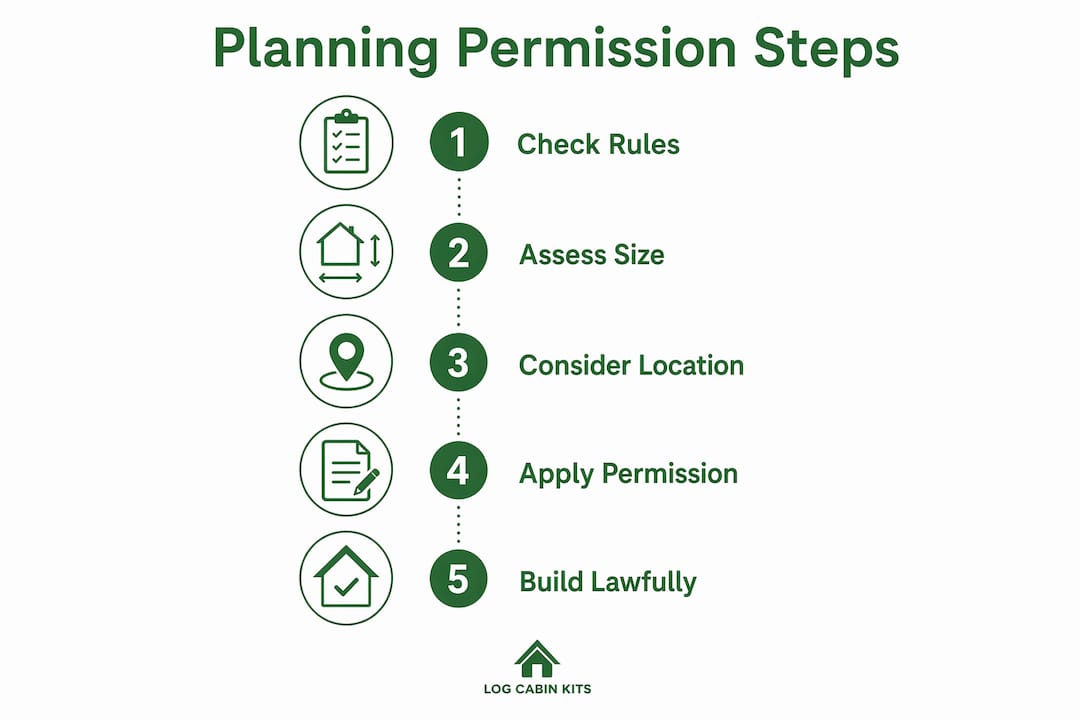
The UK Planning Portal is the clearest official starting point for checking the rules. Planning permission refusals for garden cabins most often come down to three things: exceeding size limits, using the cabin as living accommodation, or building on protected land.
Building regulations are a separate matter entirely. Planning permission covers what you build and where. Building regulations cover how it is built, including structural safety and insulation standards. Some garden log cabins fall outside building regulations; others, particularly larger or more complex builds, do not. Your local authority can confirm which applies to your project.
Ready to find your perfect garden cabin?
Logcabinkits takes the guesswork out of choosing a garden building that fits your space and stays within the rules. The range covers everything from compact garden summer houses to fully bespoke builds designed around your exact dimensions and requirements.
Every cabin is available as a self-build kit with free UK mainland delivery, and the team can help you configure a design that works within permitted development limits. If you need something truly tailored, the bespoke design service lets you specify wall thickness, roof style, door and window positions, and more. Browse the full garden log cabin range and use the cabin selection wizard to find the right fit for your garden.
Key takeaways
Most UK garden log cabins qualify under permitted development rights, so no planning application is needed if you meet the size, height, use, and location conditions.
| Point | Details |
|---|---|
| Permitted development applies | Most garden log cabins do not need planning permission if they meet size, height, and use conditions. |
| Height limits are strict | Maximum 4m with a dual-pitched roof, 3m with other roofs, and 2.5m if within 2m of a boundary. |
| Use determines legality | Cabins must be incidental to the house; self-contained living accommodation always requires planning permission. |
| Local rules can override | Article 4 Directions and listed building status remove permitted development rights entirely. |
| Logcabinkits can help | The bespoke design service helps you configure a cabin that fits your garden and stays within the rules. |
Recommended
- blog articles corner log cabin boundary planning rules | Specialist Garden Cabin Supplier
- blog articles multi room log cabin planning permission rules | Specialist Garden Cabin Supplier
- blog planning permission garden buildings uk guide | Specialist Garden Cabin Supplier
- 2.5m Log Cabins | No Planning Permission Garden Rooms