
The role of ventilation in garden rooms explained

TL;DR:
- Proper ventilation in garden rooms is essential for health, comfort, and long-term building integrity.
- Integrating MVHR systems or passive ventilation according to UK regulations ensures consistent airflow and energy efficiency.
Most garden room owners think about insulation, lighting, and flooring long before ventilation crosses their minds. Yet the role of ventilation in garden rooms is one of the most important factors affecting your health, your building’s lifespan, and your day-to-day comfort. Get it wrong, and you could be looking at mould, damp timber, and stuffy air within months. Get it right, and your garden room stays fresh, dry, and pleasant all year round. This guide walks you through everything you need to know, from UK regulations to the best systems for bespoke timber builds.
Table of Contents
- Why ventilation matters in garden rooms
- Understanding UK regulations for garden room ventilation
- Ventilation methods: passive ventilation vs MVHR systems
- Designing effective ventilation for bespoke timber garden rooms
- Maintaining ventilation systems for long-term comfort and health
- Rethinking ventilation: what most garden room owners overlook
- Enhance your bespoke garden room with expert ventilation solutions
- Frequently asked questions
Key Takeaways
| Point | Details |
|---|---|
| Ventilation prevents damage | Proper airflow avoids moisture buildup that causes mould and timber decay in garden rooms. |
| Regulations matter | UK Building Regulations require adequate ventilation, especially for rooms over 15m² used as living spaces. |
| MVHR benefits | Mechanical Ventilation with Heat Recovery supplies fresh air efficiently while saving heat to reduce energy costs. |
| Design integration | Ventilation should be planned early with airtightness and insulation for best comfort and compliance. |
| Maintenance is key | Regular filter changes and system commissioning ensure ventilation effectiveness and healthy indoor air quality. |
Why ventilation matters in garden rooms
Good ventilating your garden log cabin practice is not just about comfort. It directly affects your health, the air you breathe, and how long your building lasts.
When a garden room lacks proper airflow, moisture has nowhere to go. Everyday activities like breathing, making a cup of tea, or even just body heat produce moisture. In a sealed or poorly ventilated space, that moisture condenses on cold surfaces, and mould growth within months is a very real risk. MVHR (Mechanical Ventilation with Heat Recovery) systems filter pollutants while retaining 85 to 95% of the room’s heat, making them particularly effective for UK garden rooms.
Timber is especially vulnerable. Persistent damp softens wood fibres, encourages rot, and can compromise the structural integrity of your garden room over time.
Beyond the building fabric, poor air quality affects you directly. Trapped pollutants, carbon dioxide, and volatile organic compounds (VOCs, chemicals released from paints, furniture, and adhesives) build up in under-ventilated spaces. The result? Headaches, fatigue, poor concentration, and in some cases, worsened asthma symptoms.
Here is what good ventilation actually does for your garden room:
- Removes excess moisture before it causes condensation and mould
- Flushes out airborne pollutants and CO2
- Maintains a comfortable, stable temperature
- Protects timber and insulation from long-term moisture damage
- Supports your wellbeing during long working or leisure sessions
“A garden room without proper ventilation is not just uncomfortable — it is quietly damaging both your health and your building every single day.”
Understanding UK regulations for garden room ventilation
Ventilation is not just good practice. For certain garden rooms, it is a legal requirement. Knowing where your build sits within UK building regulations helps you stay compliant and avoid costly issues later.
UK Building Regulations 2026 (Approved Document F) require compliant ventilation such as MVHR or passive equivalents for garden rooms over 15m² used as habitable spaces. “Habitable” means rooms used regularly for living, working, or sleeping, rather than simple storage.
Part L of the Building Regulations, which covers energy efficiency, also plays a role. Airtight garden rooms are better at retaining heat, but that same airtightness means natural ventilation becomes unreliable. MVHR satisfies both Part F (ventilation) and supports Part L (energy) compliance in one system.
| Garden room size | Typical use | Ventilation likely required |
|---|---|---|
| Under 15m² | Storage, occasional hobby use | Not usually regulated |
| 15m² to 30m² | Home office, studio, gym | Passive or MVHR depending on airtightness |
| Over 30m² | Living space, annexe, bedroom | MVHR strongly recommended |
Key regulatory points to keep in mind:
- Passive ventilation (openable windows, trickle vents) can comply in less airtight builds
- Timber garden rooms need careful attention due to moisture sensitivity
- If your garden room is used daily, treat it as a habitable space regardless of size
- Always check with your local planning authority if in doubt about your specific build
Choosing the right garden room standards UK approach from the start saves significant hassle. If your garden room includes opening windows, it is worth considering how those garden room window choices affect both airflow and compliance.
Ventilation methods: passive ventilation vs MVHR systems
There are two main approaches to ventilating a garden room. Both have genuine merits, but they suit very different types of builds and uses.
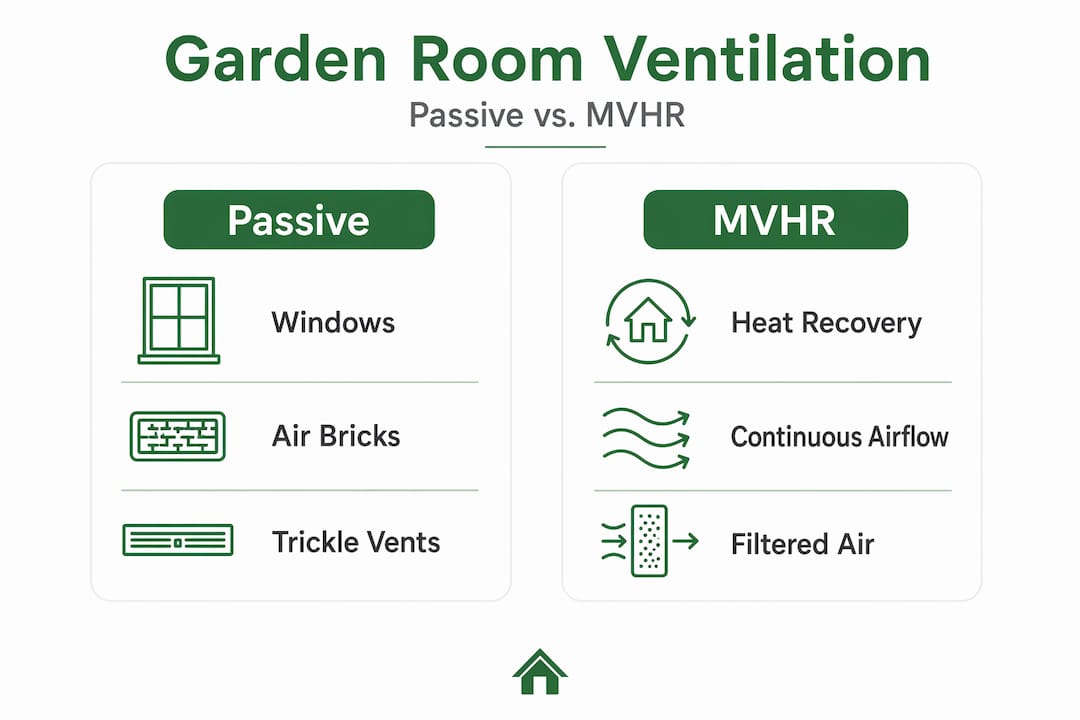
Natural ventilation (also called passive ventilation) relies on openings such as windows, doors, trickle vents, and air bricks to allow air to move in and out naturally. It works well in smaller, less airtight garden rooms where you can physically open windows regularly. The downside is inconsistency. On still days, airflow drops. In winter, you face a trade-off between fresh air and warmth. Passive cross-ventilation uses openings to create airflow and requires at least 150mm underfloor ventilation to prevent rot and moisture in timber builds.
MVHR (Mechanical Ventilation with Heat Recovery) is the more advanced option. A small unit continuously draws fresh air in and pushes stale air out, passing both streams through a heat exchanger. MVHR systems cost £3,000 to £7,000, recover 90 to 95% of the room’s heat, and provide continuous fresh air at 0.5 air changes per hour, making them ideal for year-round UK use.
| Feature | Passive ventilation | MVHR system |
|---|---|---|
| Upfront cost | Low (£100–£500) | Higher (£3,000–£7,000) |
| Heat loss | Significant | Minimal (90–95% recovery) |
| Air quality control | Dependent on weather | Continuous and consistent |
| Suitable for airtight builds | Limited | Yes |
| Maintenance | Minimal | Annual filter changes |
| Compliance (Approved Document F) | Possible in smaller builds | Yes |
Useful pointers when choosing between the two:
- Use passive ventilation for occasional-use garden rooms under 15m²
- Choose MVHR for home offices, studios, or any space used daily
- Always ensure 150mm underfloor clearance for passive systems on timber frames
- Factor in ongoing running costs, MVHR units typically use 20 to 30 watts of electricity
Pro Tip: Explore the full range of ventilation strategies for garden rooms before committing to a system. Pairing MVHR with efficient heating and ventilation planning from the outset saves money and effort down the line.
Designing effective ventilation for bespoke timber garden rooms
The best time to plan your ventilation is before a single panel goes up. Retrofitting ventilation into a finished garden room is possible but expensive and disruptive. Planning ahead keeps things neat, effective, and cost-efficient.
Here is a step-by-step approach for bespoke timber builds:
- Decide on your ventilation strategy early. Work out how airtight your build will be and whether you need MVHR or passive systems. Your insulation specification determines this.
- Design for balanced airflow. Supply air should come into living and working areas; extract air should be drawn from kitchenettes, bathrooms, or high-moisture zones.
- Allow 150mm underfloor clearance. Even with MVHR, underfloor airflow matters for preventing ground moisture from affecting your timber base.
- Route ductwork through timber panels and floor cavities. In bespoke builds, ducts can be concealed neatly within the structure. Plan duct runs before insulating to avoid gaps and thermal bridging.
- Commission the system properly. Balancing supply and extract rates after installation is critical. A poorly commissioned system can cause draughts, noise, or uneven air distribution.
- Plan for filter access. MVHR filters need changing annually. Make sure the unit is accessible without removing cladding or fixtures.
MVHR is essential for airtight timber garden rooms to comply with Part F and support Part L energy efficiency by preventing indoor air quality issues. If your insulated timber garden rooms design aims for high performance, MVHR is not a luxury. It is the natural complement to good insulation.
Pro Tip: Ask your supplier to pre-install duct sleeves through structural panels during manufacture. It costs very little at the build stage but saves hours of work later.
Maintaining ventilation systems for long-term comfort and health
A well-designed system that nobody maintains is not much use. Routine upkeep keeps your garden room fresh, your system efficient, and your timber protected year after year.
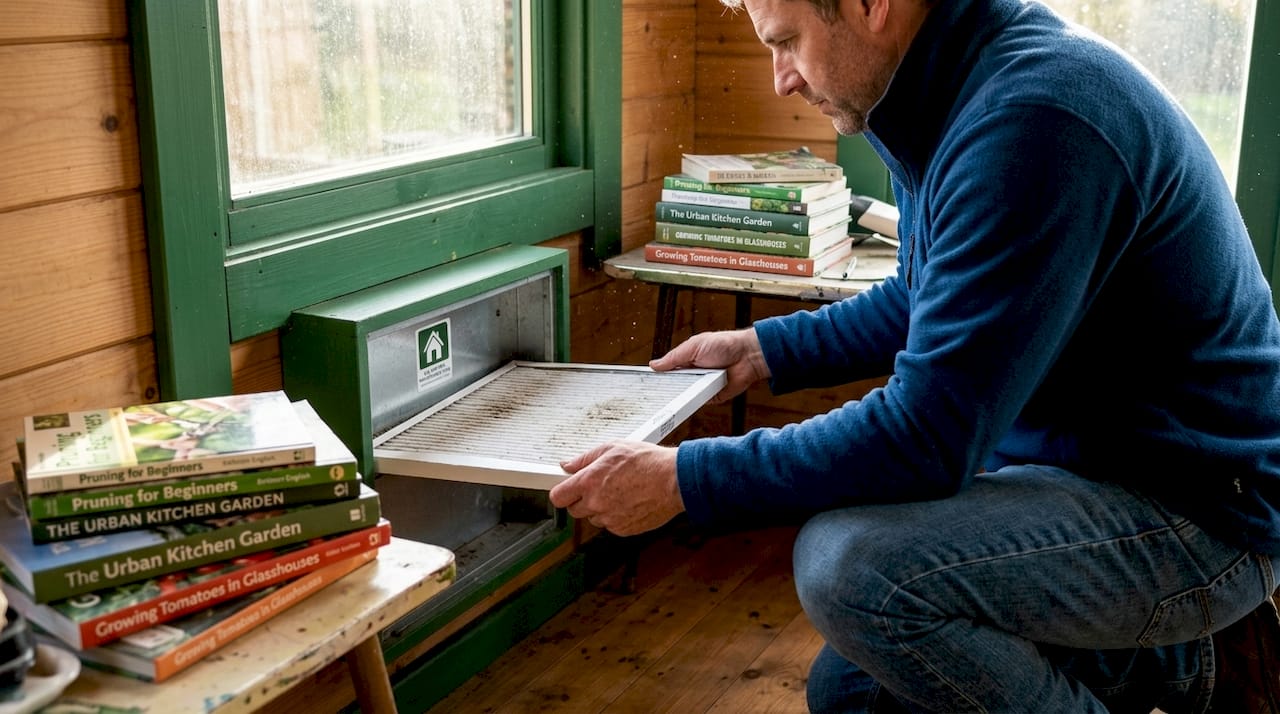
MVHR commissioning is critical but often skipped. Balancing supply and extract, annual filter changes, and using the summer bypass feature all prevent efficiency loss and overheating. Many owners skip commissioning entirely, then wonder why the system sounds noisy or feels ineffective.
Key maintenance tasks to keep on top of:
- Change filters annually. Most MVHR units take standard G4 and F7 filters. Clogged filters reduce airflow and let pollutants through.
- Use the summer bypass. In warmer months, your system can route incoming air around the heat exchanger. This avoids warming your garden room unnecessarily.
- Check for musty smells or condensation. These are early warning signs that something is off, whether a blocked duct, a leaking seal, or a failing filter.
- Inspect trickle vents and air bricks in passive systems. Leaves, debris, and spider webs are surprisingly common culprits for blocked ventilation maintenance tips.
- Keep duct terminals clear. External terminals can get blocked by vegetation or nesting birds. A quick visual check each spring takes two minutes.
Pro Tip: Set a phone reminder each March to check your MVHR filters and clean external terminals. Doing it before the warm season means your summer bypass works properly when you actually need it.
Rethinking ventilation: what most garden room owners overlook
Here is something we see time and again. A customer invests heavily in insulation, high-quality timber, and beautiful interiors, then treats ventilation as an afterthought. Sometimes it is a couple of trickle vents and a hope for the best. Within a year, there is condensation on windows, a faint musty smell, and in the worst cases, visible mould on the north-facing wall.
The common misconception is that “just opening a window” is equivalent to a ventilation strategy. It is not. Particularly in airtight, well-insulated garden rooms, which are the kind worth building if you want year-round comfort, natural airflow simply cannot deliver the consistency you need.
Poor ventilation silently damages health and building fabric over time. Integrated MVHR systems, designed as a complete unit from the start, provide predictable and superior indoor environments compared to patched-together passive solutions.
What separates a garden room that performs beautifully for 20 years from one that needs remedial work within five? Usually, it comes down to three things. First, ventilation was planned at the design stage, not bolted on afterwards. Second, the system was properly commissioned by someone who understood airflow balancing. Third, the owner kept up with basic maintenance rather than ignoring the unit once it was installed.
We also see people underestimate how much energy MVHR saves over time. Yes, the upfront cost is higher than a trickle vent. But when you are recovering 90 to 95% of your heat through the exchanger, you are heating your garden room with far less energy. Combined with good insulation, MVHR makes energy efficiency and ventilation work together rather than against each other.
The honest advice? Budget for MVHR from day one. Treat it as part of the build, not an optional extra. You will thank yourself every time you walk into a crisp, fresh garden room in February.
Enhance your bespoke garden room with expert ventilation solutions
If this guide has got you thinking seriously about your garden room ventilation, the next step is finding a build that makes it easy to get right from the start.

Our quality garden log cabins are crafted with UK conditions in mind, with options to integrate ventilation at the design stage so you are not retrofitting anything later. Whether you want a fully bespoke layout or a custom timber specification, our bespoke cabin design options and custom build log cabins let you specify exactly what you need. We offer free UK delivery and a team ready to help you work out the right ventilation approach for your space, your use, and your budget. Come and explore what is possible.
Frequently asked questions
Do garden rooms always need mechanical ventilation?
Not always. Smaller or less airtight garden rooms can use passive ventilation, but MVHR is often necessary for sealed or habitable garden rooms over 15m² to meet Part F requirements and maintain acceptable air quality.
How much airflow is needed underneath a garden room?
A minimum of 150mm underfloor clearance is recommended. Underfloor airflow of 150mm via grilles or air bricks prevents rot, moisture buildup, and structural issues in timber garden rooms.
What maintenance does an MVHR system need?
Annual filter changes, a yearly commissioning check to balance airflow, and correct use of the summer bypass mode are the essentials. Filters changed annually and proper commissioning keep the system running efficiently without overheating.
Can I open windows if I have MVHR in my garden room?
Yes, absolutely. MVHR works alongside open windows rather than replacing them, providing continuous baseline ventilation whether windows are open or closed for natural airflow.