
Understanding cabin warranties: a homeowner’s guide

TL;DR:
- A cabin warranty is a written promise to repair specific defects in materials or workmanship for a set period. Homeowners should understand warranty coverage, exclusions, and how to effectively file claims while maintaining proper documentation. Statutory rights under the Consumer Rights Act 2015 support consumers beyond warranty terms and should be used if repairs are refused.
A cabin warranty is a formal promise from a manufacturer or installer to fix specific defects in materials or workmanship for a set period. It gives you real protection beyond basic consumer rights, but only if you know what it covers, what it excludes, and how to use it properly. Understanding cabin warranties before you sign anything is the single most effective way to protect your investment in a garden log cabin.
What does cabin warranty coverage typically include and exclude?
Cabin warranty coverage is not a blanket protection for everything that could go wrong. Most warranties are tiered, meaning different parts of your cabin carry different coverage periods. Structural warranty tiers typically assign 10 years to major elements such as the base, walls, and roof frame, while doors, windows, and hardware receive shorter periods. That structure reflects how long each component is expected to last under normal conditions.
What is usually covered:
- Structural elements: base, wall logs, roof structure
- Installation workmanship defects
- Windows and external doors (for a shorter period than the structure)
- Manufacturer defects in timber or fixings
What is usually excluded:
- Natural timber ageing, colour change, and surface checking (small surface cracks)
- General wear and tear on hinges, locks, and seals
- Accidental damage caused by the homeowner
- Weather damage beyond the cabin’s stated specification
- Damage caused by poor maintenance or neglect
One point that catches many homeowners off guard: warranties cover defects, while insurance covers sudden events like fire, storm damage, or theft. These are two separate protections, and you need both. Relying on your warranty alone leaves your cabin exposed to risks it was never designed to cover.
Pro Tip: Ask your supplier for a written breakdown of warranty tiers by component before you pay a deposit. If they cannot provide one, treat that as a warning sign.
How do UK statutory rights support cabin owners beyond warranty promises?
Statutory rights are the legal floor beneath any warranty. The Consumer Rights Act 2015 requires that all installation work is carried out with reasonable care and skill. This applies whether or not you have a warranty, and it cannot be removed by any contract term.
Your rights under the Act are straightforward:
- Request a repair or redo. If the installation is defective, the trader must fix it at no extra cost within a reasonable time.
- Ask for a price reduction. If the repair is not completed properly, you can claim a reduction in what you paid.
- Demand a refund. In serious cases where the work cannot be put right, you may be entitled to a full or partial refund.
- Act within a reasonable timeframe. Report defects as soon as you notice them. Delays can complicate your position.
Under the Consumer Rights Act 2015, traders must correct defective installations at no extra cost, within a reasonable time, and without causing significant inconvenience to the homeowner. Consumers must give the installer a chance to fix the problem before demanding a refund or price reduction.
The practical takeaway is this: your statutory rights and your warranty work together. Use the warranty first for straightforward defects. If the installer refuses to act, your statutory rights give you a legal route to push further. Knowing both protections exist puts you in a much stronger position.
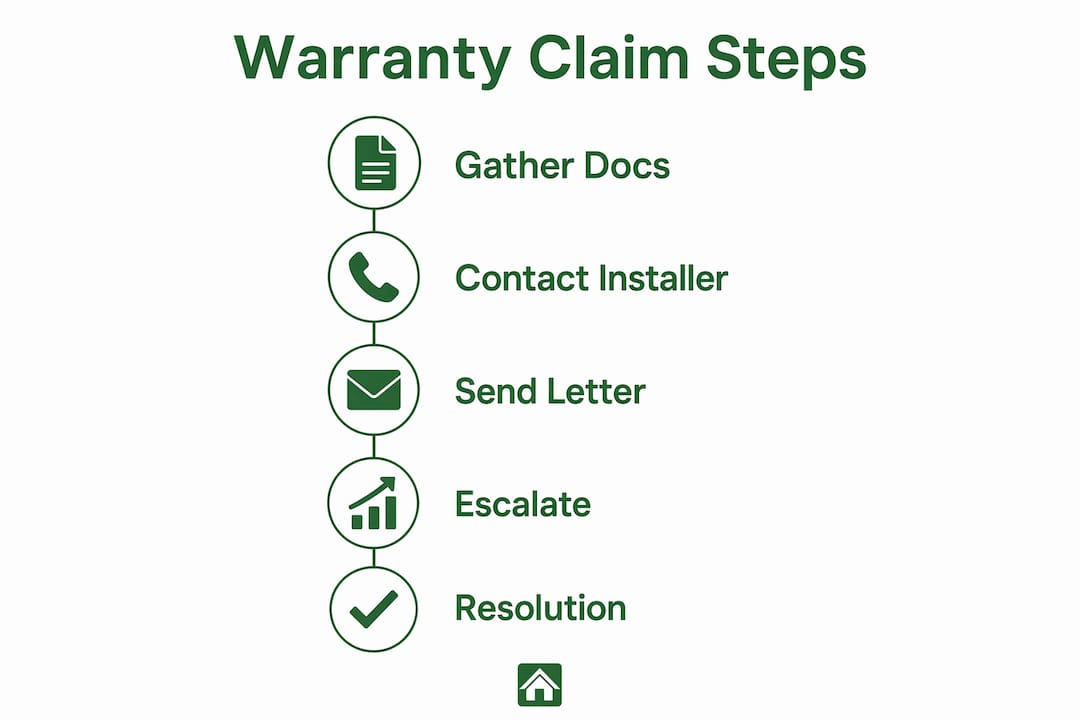
What steps should homeowners follow when making a warranty claim?
A warranty claim succeeds or fails on the quality of your evidence. The process is not complicated, but it does require you to be organised from day one.
Before you pay:
- Obtain the full written warranty document, not just a summary or verbal assurance
- Check that written warranty terms are included as a condition of your contract, alongside compliance certificates and care instructions
- Confirm the warranty is from the manufacturer or installer directly, not a third party you cannot contact
When a defect appears:
- Photograph and video the issue immediately, with date stamps visible
- Write down exactly when you first noticed the problem and what conditions preceded it
- Get a written assessment from an independent professional if the defect is significant. Written independent reports carry far more weight than verbal opinions in any dispute.
Making the formal claim:
- Submit your request in writing, by email or recorded post
- Reference both your warranty terms and your rights under the Consumer Rights Act 2015
- Keep copies of every communication, including any responses from the installer
Pro Tip: If the installer goes quiet or refuses to engage, send a formal letter before action giving them 14 days to respond. This creates a paper trail and signals you are prepared to escalate.
If the installer still refuses to act, you can escalate to a trading standards body, use an alternative dispute resolution scheme, or pursue a small claims court action. The key is that you have everything in writing before you reach that stage.

How do bespoke or custom cabins affect warranty claims?
Bespoke cabins add a layer of complexity to warranty claims that standard builds do not carry. When a cabin is tailored to your exact specifications, proving that something is a defect rather than a consequence of your own design choices becomes harder. Custom cabin specifications require detailed contracts and clear documentation to reduce the risk of disputes later.
The table below shows how warranty considerations differ between standard and bespoke builds:
| Area | Standard cabin | Bespoke cabin |
|---|---|---|
| Defect definition | Clear, based on product spec | Requires comparison to agreed contract spec |
| Full rejection or refund | More straightforward | Harder to establish without detailed contract |
| Snagging process | Standard checklist applies | Must be tailored to bespoke elements |
| Evidence needed | Product documentation | Detailed drawings, material specs, and sign-off records |
| Contract importance | Important | Critical |
The snagging process, where you check the finished build against what was agreed, is especially important for bespoke cabins. Walk through the build with your installer before final sign-off and note every item that does not match the agreed specification. Get the installer to sign a snagging list acknowledging outstanding items. That document becomes part of your warranty evidence if problems arise later.
Logcabinkits specialises in bespoke cabin design and works with homeowners to produce clear written specifications from the outset. That clarity protects both sides and makes warranty claims far simpler to resolve.
What common pitfalls should cabin owners avoid?
Most warranty disputes do not happen because the warranty was bad. They happen because the homeowner made avoidable mistakes before or during the build. These are the most common ones.
- Accepting verbal promises. A verbal guarantee is worth nothing in a dispute. Verbal promises are insufficient for warranty claims. Get everything in writing before you pay.
- Confusing warranty with insurance. Your warranty covers defects. Your home insurance or a specialist buildings policy covers accidents, storms, and theft. You need both, not one or the other.
- Skipping maintenance requirements. Warranty terms commonly include maintenance obligations such as annual cleaning, re-treating timber, and lubricating hinges. Failing to meet these can void your coverage entirely.
- Paying in full before receiving documents. Never pay the final balance before you have the warranty certificate, compliance documents, and care instructions in hand.
- Failing to preserve evidence. If you notice a defect and do nothing for months, your claim becomes much harder to pursue. Report problems promptly and keep a record.
Pro Tip: Set a calendar reminder each year to carry out basic cabin maintenance and photograph the condition of the structure. This creates an ongoing record that supports any future warranty claim.
Understanding warranty policies for your cabin from the start is far easier than trying to unpick a dispute after the fact.
Key takeaways
A cabin warranty only protects you fully when you have it in writing, understand its limits, and pair it with your statutory rights under the Consumer Rights Act 2015.
| Point | Details |
|---|---|
| Warranties are tiered | Structural elements get longer coverage than doors, windows, and hardware. |
| Statutory rights run alongside warranties | The Consumer Rights Act 2015 applies regardless of warranty terms. |
| Documentation wins disputes | Dated photos, videos, and independent written reports are your strongest evidence. |
| Bespoke builds need detailed contracts | Custom cabins require precise written specs to define what counts as a defect. |
| Maintenance keeps warranties valid | Failing to maintain your cabin can void coverage, so keep records of annual upkeep. |
What I have learned from watching warranty disputes unfold
After years of working with homeowners on garden cabin projects, the pattern in warranty disputes is almost always the same. The homeowner trusted a verbal assurance. The installer moved on to the next job. When something went wrong, there was nothing in writing to fall back on.
The fix is not complicated. Demand written warranty terms before you pay a single penny of the final balance. Read them. If a clause seems vague, ask for clarification in writing. A supplier who resists that request is telling you something important.
Maintenance is the other area where I see homeowners lose coverage they thought they had. Timber needs annual treatment. Hinges need lubrication. Gutters need clearing. These are not onerous tasks, but skipping them hands the installer a reason to reject your claim. Keep a simple log of what you did and when.
The good news is that most reputable suppliers want to resolve problems quickly. A clear contract, a solid warranty document, and a homeowner who reports defects promptly makes resolution straightforward for everyone. The installation guide at Logcabinkits is a good starting point for understanding what proper workmanship looks like, which helps you spot when something is not right.
— Martin
Garden log cabins from Logcabinkits: quality you can rely on
Logcabinkits offers a wide range of garden log cabins built from quality timber, with clear warranty documentation provided as standard. Whether you are looking at a standard apex-roof cabin or a fully bespoke build tailored to your garden, every cabin comes with written warranty terms you can review before committing.

The team at Logcabinkits also offers a professional installation service, so your cabin is fitted to the standard required by both your warranty and the Consumer Rights Act 2015. If you want to see the full range before deciding, the cabin selection wizard makes it easy to find the right building for your space and budget.
FAQ
What is a cabin warranty?
A cabin warranty is a written guarantee from a manufacturer or installer to repair or replace defective materials or workmanship within a defined period. It is separate from your statutory rights under the Consumer Rights Act 2015.
How long does a cabin warranty typically last?
Warranty tiers typically assign 10 years to structural elements such as walls and roof, with shorter periods for doors, windows, and hardware. Always check the specific terms for each component.
Does a cabin warranty cover weather damage?
Standard cabin warranties exclude weather damage beyond the cabin’s stated specification. Damage from storms, flooding, or fire is covered by home insurance, not a warranty.
Can I claim under my warranty and statutory rights at the same time?
Yes. Your statutory rights under the Consumer Rights Act 2015 apply independently of any warranty. You can use both protections together, and one does not cancel out the other.
What voids a cabin warranty?
Failure to meet maintenance requirements such as annual timber treatment and cleaning can void warranty coverage. Accidental damage caused by the homeowner and modifications made without approval also commonly void claims.