
One of the most common questions homeowners ask when purchasing a log cabin, garden office, garden room, workshop or timber building is whether planning permission will be required. In many cases, log cabins can be installed under Permitted Development rights, avoiding the need for a formal planning application. However, one of the most important considerations is how close the building will be positioned to a garden boundary.
The location of a log cabin relative to fences, walls and neighbouring properties can have a significant impact on the maximum allowable height. Understanding the UK's critical 2.5-metre height rule is essential before selecting a building design or preparing a base.
This guide explains how planning regulations apply to log cabins positioned close to boundaries, in particular, space-saving corner log cabins, how the 2.5-metre rule works, and how homeowners can maximise usable space while remaining compliant with UK planning legislation.
What Are Permitted Development Rights?
Permitted Development rights allow homeowners to carry out certain improvements and additions to their property without applying for full planning permission.
Many garden buildings fall within these rights, including:
- Log cabins
- Garden rooms
- Garden offices
- Timber garages
- Workshops
- Studios
- Summer houses
However, specific rules govern their size, location and height.
One of the most important restrictions concerns buildings located near property boundaries.
The Critical 2.5-Metre Height Rule Explained
The rule that catches out many homeowners is straightforward:
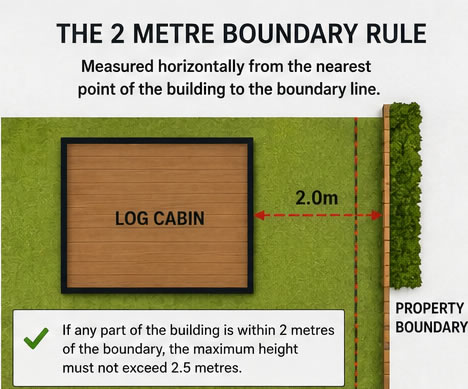
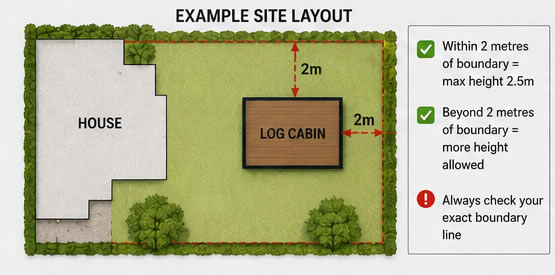
If any part of the building is situated within 2 metres of a property boundary, the maximum overall height of the structure must not exceed 2.5 metres.
This is measured from the highest natural ground level immediately adjacent to the building.
The restriction applies regardless of whether the building is:
- A log cabin
- A garden office
- A workshop
- A timber garage
- A summer house
It also applies regardless of roof type.
Understanding What Counts as a Boundary
A boundary is not simply the visible fence line.
For planning purposes, the boundary refers to the legal edge of your property.
This may include:
- Timber fences
- Brick walls
- Garden hedges
- Neighbouring property lines
- Rear garden boundaries
- Side garden boundaries
The 2-metre measurement is taken horizontally from the nearest part of the building to the nearest legal boundary.
If even one corner of the structure falls within this zone, the entire building becomes subject to the 2.5-metre height restriction.
How Building Height Is Measured
Many homeowners assume that wall height is the key measurement. In reality, planners measure the highest point of the structure.
This means:
- Flat roof buildings are measured to the roof surface.
- Pent roof buildings are measured to the highest edge of the roof.
- Apex roof buildings are measured to the ridge.
The highest point must remain below 2.5 metres when the building is located within 2 metres of a boundary.
Why Modern Log Cabins Often Use Flat Roofs
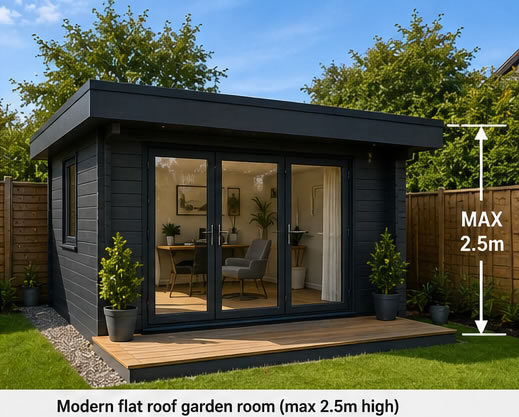
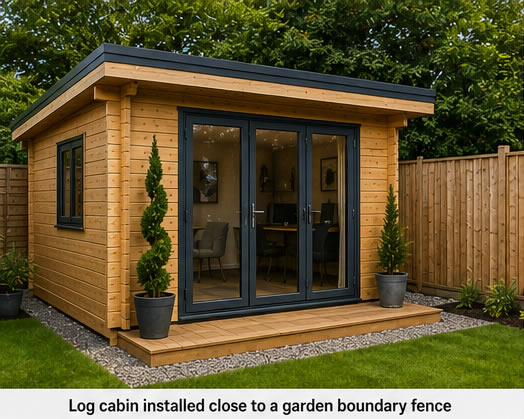
The popularity of contemporary flat-roof garden rooms has increased significantly due to planning regulations.
Flat roof designs make more efficient use of the available height allowance.
For example, a modern flat roof garden office may achieve:
- External height of 2.45 metres
- Internal ceiling height of over 2.2 metres
- Full-height glazing
- Contemporary styling
This creates a spacious interior while remaining fully compliant with the 2.5-metre rule.
As a result, flat roof buildings are particularly popular in smaller gardens where boundary proximity is unavoidable.
Pent Roof Cabins and Boundary Restrictions
Pent roof cabins feature a single roof slope and are another popular option for boundary installations.
These buildings provide:
- Improved rainwater drainage
- Modern aesthetics
- Increased ceiling height at one side
- Efficient use of permitted height
When installed within 2 metres of a boundary, the highest point of the roof must remain below 2.5 metres.
Manufacturers often design pent roof cabins specifically to maximise internal headroom while remaining within permitted development limits.
The Challenges of Apex Roof Cabins Near Boundaries
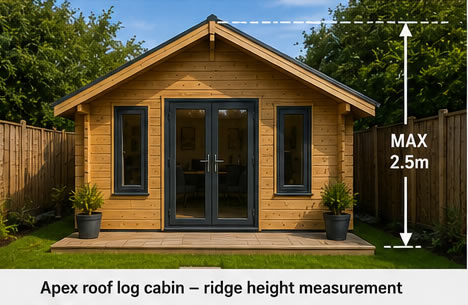
Traditional apex cabins remain extremely popular due to their attractive appearance and vaulted interior spaces.
However, apex roofs can be more restrictive when positioned close to a boundary.
Because the roof rises to a central ridge, some of the available height allowance is consumed by the roof pitch itself.
To keep the ridge below 2.5 metres:
- Wall heights may need to be reduced.
- Door heights may be restricted.
- Internal volume may be reduced.
- Furniture positioning may become more difficult.
This is why many homeowners opt for contemporary roof styles when installing buildings near garden fences.
What Happens Beyond the 2-Metre Boundary Zone?
The regulations become more flexible when a building is located more than 2 metres from every boundary.
Under Permitted Development rights, detached outbuildings can generally reach:
- 4 metres overall height for dual-pitched roofs.
- 3 metres overall height for all other roof types.
This allows much larger apex cabins to be installed without planning permission, provided all other requirements are satisfied.
For larger gardens, moving the building further from boundaries can significantly increase design flexibility.
Common Planning Mistakes Homeowners Make
Several common misunderstandings regularly lead to planning complications.
Assuming the Fence Is the Boundary
The visible fence may not accurately represent the legal boundary line. Always verify property boundaries before positioning a building.
Measuring from the Base Instead of the Roof
Planners measure to the highest point of the building, not the wall height.
Ignoring Roof Overhangs
Large roof overhangs may affect measurements and should be included when calculating distances to boundaries.
Building on Raised Ground
Height measurements are taken from the highest adjacent natural ground level. Artificially raising the site may create planning issues.
Additional Planning Restrictions to Consider
Even if a building complies with the 2.5-metre height rule, other restrictions may still apply.
Examples include:
- Listed buildings
- Conservation areas
- National Parks
- Areas of Outstanding Natural Beauty
- Article 4 Directions
Properties within these designations may require additional approvals regardless of size or height.
Best Practices When Planning a Boundary Installation
Before purchasing a log cabin, homeowners should:
- Confirm the exact legal boundary position.
- Measure available space carefully.
- Check the building's overall external height.
- Consider roof style carefully.
- Allow room for maintenance access.
- Review local planning constraints.
Taking these steps early in the process can prevent costly redesigns and installation delays.
Choosing the Right Cabin Design for a Small Garden
Where space is limited, modern flat roof and pent roof cabins often provide the most practical solution.
These designs maximise internal floor area and headroom while remaining within the strict 2.5-metre height limit.
Combined with large glazed doors, slim roof structures and contemporary finishes, they create spacious and attractive interiors despite planning restrictions.
Traditional apex cabins remain an excellent choice where larger gardens allow the building to be positioned more than 2 metres from all boundaries.
Frequently Asked Questions
Can I place a log cabin directly next to a fence?
Yes, provided the overall height does not exceed 2.5 metres and all other Permitted Development requirements are met.
Does the 2.5-metre rule apply to all roof styles?
Yes. If the building is within 2 metres of a boundary, the highest point of any roof style must remain below 2.5 metres.
Can I have an apex roof within 2 metres of a boundary?
Yes, but the ridge must remain below 2.5 metres, which may reduce internal headroom.
Do I need planning permission if my cabin is 2.6 metres high?
If the building is within 2 metres of a boundary, planning permission would generally be required.
Conclusion
The 2.5-metre boundary rule is one of the most important planning considerations when installing a log cabin in the UK. While many garden buildings can be erected under Permitted Development rights, their proximity to fences and property boundaries directly influences the maximum allowable height.
For cabins located within 2 metres of a boundary, the overall height must not exceed 2.5 metres. This makes flat roof and pent roof designs particularly attractive because they maximise usable interior space while remaining compliant. Apex roof cabins can still be used but often require compromises in wall height and internal volume.
Understanding these regulations before purchasing a cabin helps ensure compliance, avoids planning complications and allows homeowners to select the most suitable design for their available space.